Latex gear, an old steam trunk, a four-foot crawl space, and an LA heat wave.
Never a good combination. Especially for coconut oil. Celibacy had prompted this little tyke to tap into the old toy trunk and, to my horror, I found cotton fiber bags and melted blobs of ultra-realistic UR3 material.
A travesty.
But soon I discovered a simple box with very distinct camo tape. Identifiable to any enthusiast. And inside the box, a brand new 9-by-8-inch real deal dong labeled “8.0.”
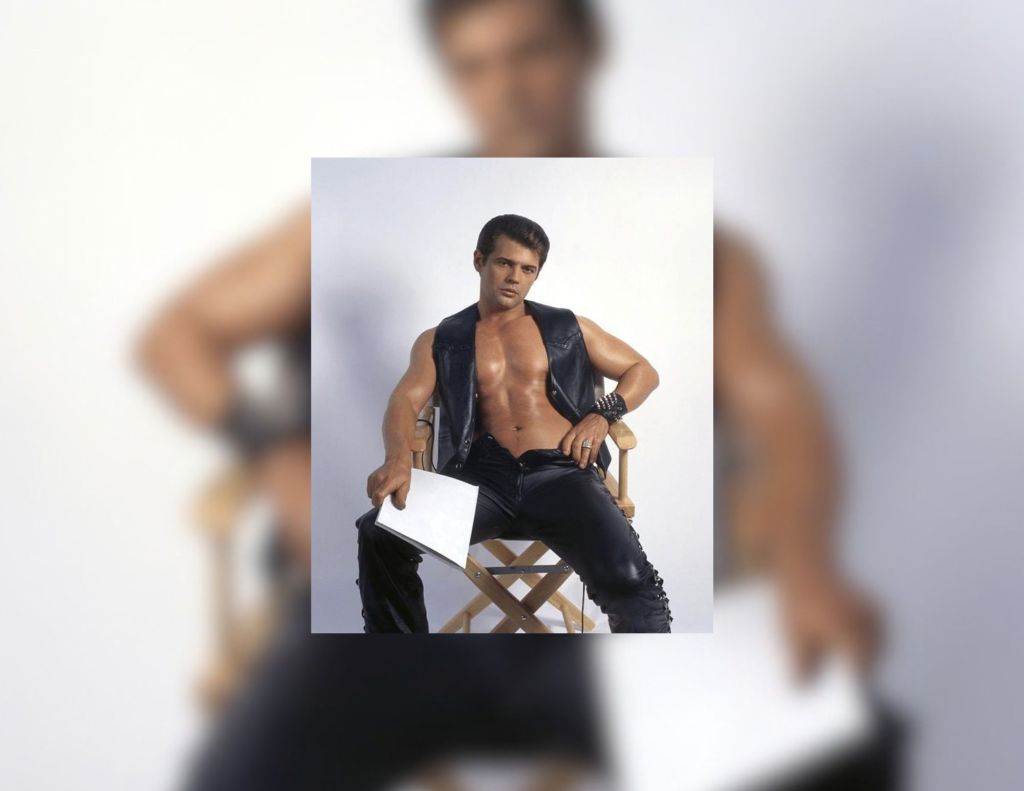
Yet another travesty, because clearly, it is the mold of one very famous Jeff Stryker.
I’d deem it the end of an era.
Jeff Stryker belonged to an era when porn stars were actually stars. Muscular, mustached, and unapologetically masculine, he became an archetype of gay male desire long before an endless scroll could produce a new one every thirty seconds. His image became recognizable enough that even his anatomy became merchandise. The mold wasn’t simply a sex toy; it was a little piece of gay cultural history sitting in my trunk.
Millennials fuck everything up. Well, technically, it is not our fault; we simply existed in the transitional age of the internet, catalysts for a changing culture unbeknownst to us. The culture that preceded ours is merely history, and who cares about that? Darwinism happened, and amateurs, among other frustrating culprits, killed the porn industry.
Anything can be porn if you try hard enough.
When I was growing up, at first glance, rural hometown Texas seemed wholesome and pure. But in the shadows, about a dozen adult venues of glory hole bookstores lay hidden in plain sight. Even an infamous drive-in theater where you pull up your car to adult films projected on a massive screen. I remember listening to its AM radio station audio as a hormonal adolescent who got off in 30 seconds to the dubbing of moans and groans along with brown chicken brown cow music.
At 18, intrigue struck, I’d discovered the culture within: theaters of straight and gay porn. Little rooms and booths with screens you can feed dollar bills into, an adult arcade. Inside, holes in the wall connected these booths where unheard-of promiscuity occurs at all hours. I deemed the culture: when he didn’t get the girl, you got the load.
Anonymity. The concept became conquest. I’d found myself in situations curated by the fantasy where I would be sought out by a guy who needed it so bad he was bending his social status, matrimony, or religion, because most who seek it are bound to family or are of a devout frame of mind.
Jeff Stryker had a film, a Gino Production, titled Underground, and it depicted this prominent conservative man who, after work hours, would fall into this deviant, sexually driven force that took place at a sex club. The kitsch and camp of it caused instant erections among those who are infamously and posthumously forgotten in the Pornhubs of today. Residing in the category of “vintage.”
Folks just like to see other normal folks get it on. Self-made porn. Who hasn’t made a porno or taken a dick pic themselves?
Once upon a time, I made a production porno. It was terrible; a random dude sent me a text message, and then it was shot at some random dude’s house in the Valley, who wasn’t aware that there would be a porno shot at his house that day. The director argued with his assistant, and I had to show the cameraman how to set his white balance. I was terribly out of shape and ironically played the role of an assistant. I cringe when random folks are like, “Is this you?”
Eventually, I prevailed in a small claim to fame. This is why I know a Banksy approach to artistry is possible in some form. It all came from the notion of oral fixation and anonymity, and it was cloaked in none other than a mask. Two pieces of plywood and a center hole, collapsible and attachable to my bedroom door. Try explaining why to the lumber cutter at Home Depot… In an instant, I was an amateur porn star getting upwards of $800 checks. All for curating a fantasy of anonymity.
And success. However, minute fame and fortune, like all things, must come to an end. The action and geographical area became oversaturated with others seeking the same fantasy, and the funny thing is, the only business venture I’d succeeded at was getting paid to suck dick.
Gross, right?
Like a boy playing with his toys, they eventually get old. So, they move on to the next thing, the next level of excitement and thrill, and that doesn’t change as an adult. You still sit there playing with your toys with this intense, vivid imagination about moving on to the next thing. It’s escapism in every form.
So sometimes sticking to classics works. A Jeff Stryker mold. And when you’re done, you clean it up and place it back in your toy trunk until the next playtime.
And within the same trunk over the years, you’ve accumulated all the gadgets and gizmos, gear, custom-made chaps, jockstraps. I counted 28 the other day, and for what? Worn only to clean the house or for a needed boost of confidence. They say wearing something that makes you feel sexy underneath bolsters confidence; I can attest to that. I even have a Jeff Stryker action figure, in mint condition, still in the plastic.
But that Stryker mold became legend. Even if folks have no clue whose penis mold they are sticking up their butt. It set a standard.
What becomes of those things when they surpass the category of “vintage,” or the folks or movements or eras that set standards? In this day and age, what is the relevance of the past?
We are what we see, and we roll with trends and fads as much as we subconsciously attempt not to. Uninhibited primal instincts allow us to get off and move on with our lives. The origins are irrelevant and surely obsolete.
But boy, did a man clad in leather depicting moral-bending scenes of sex and vice change a little boy’s deviant secret life.
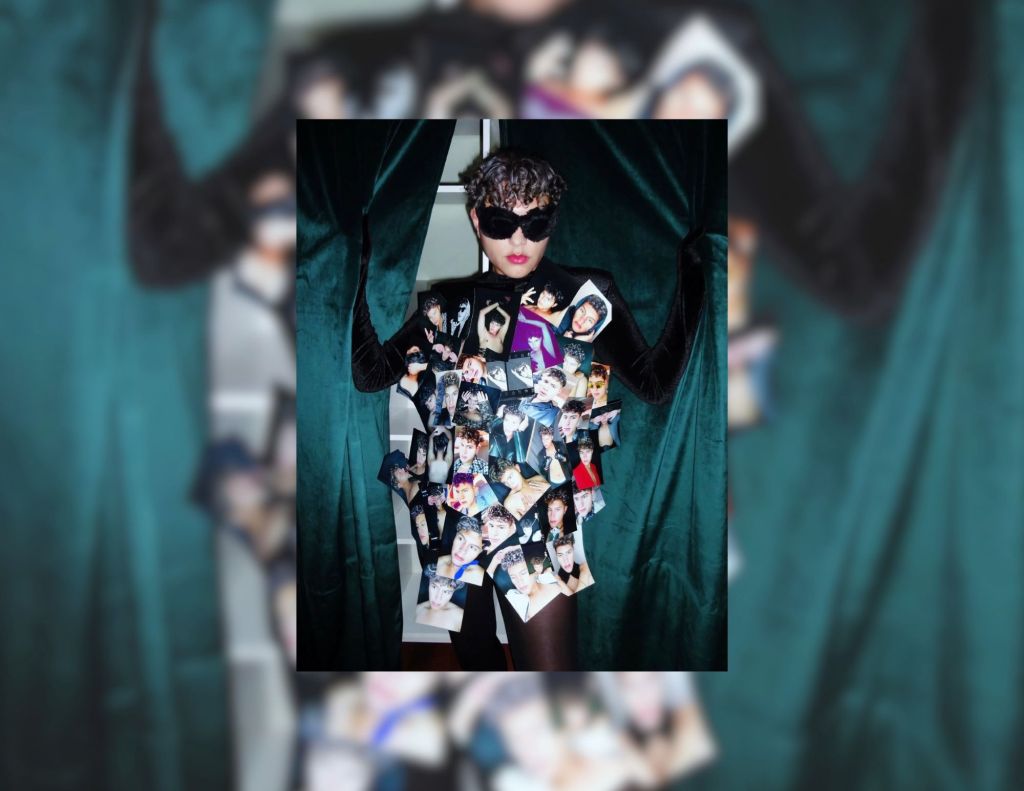
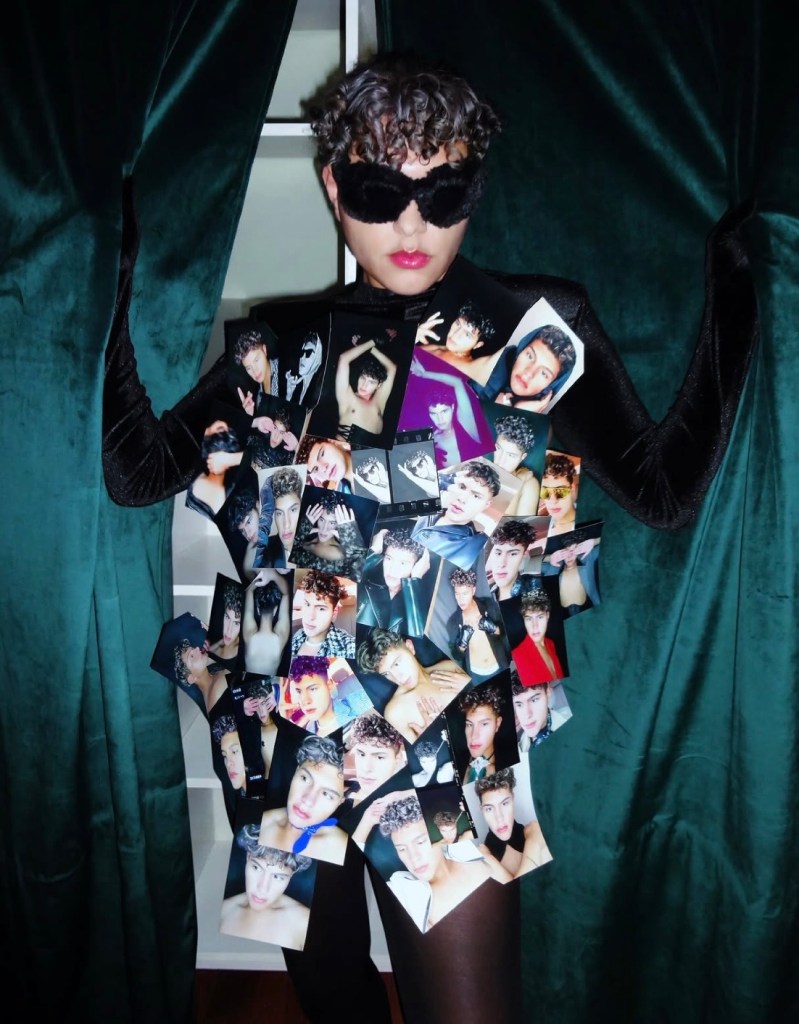
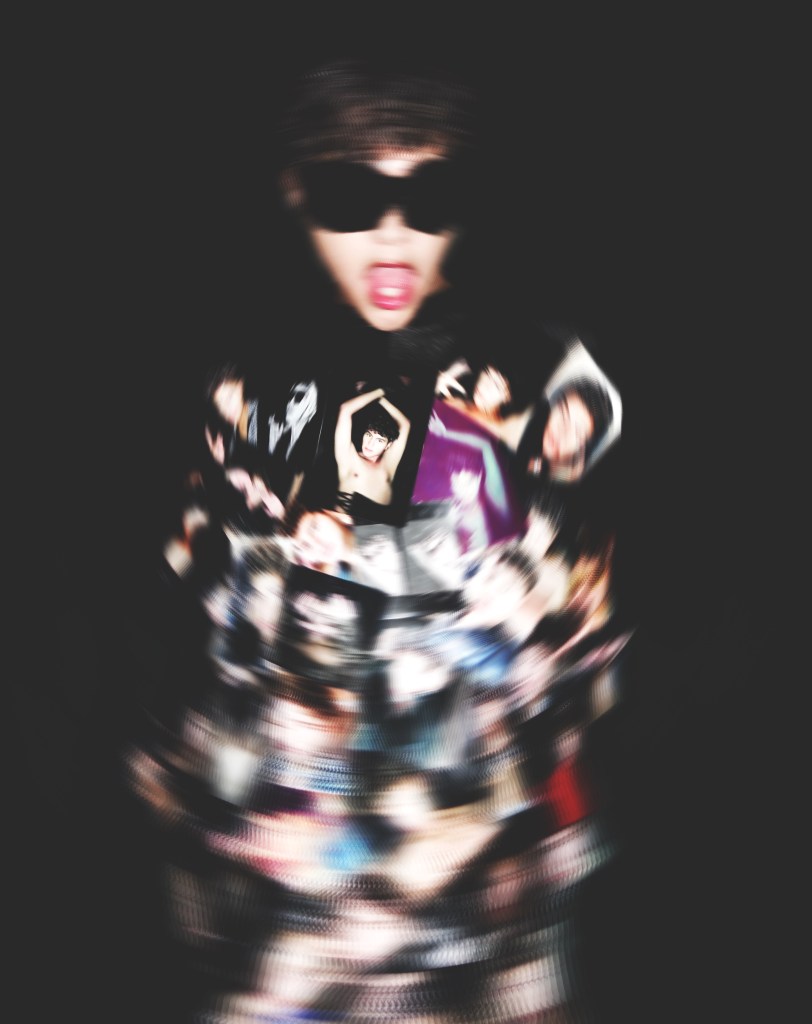
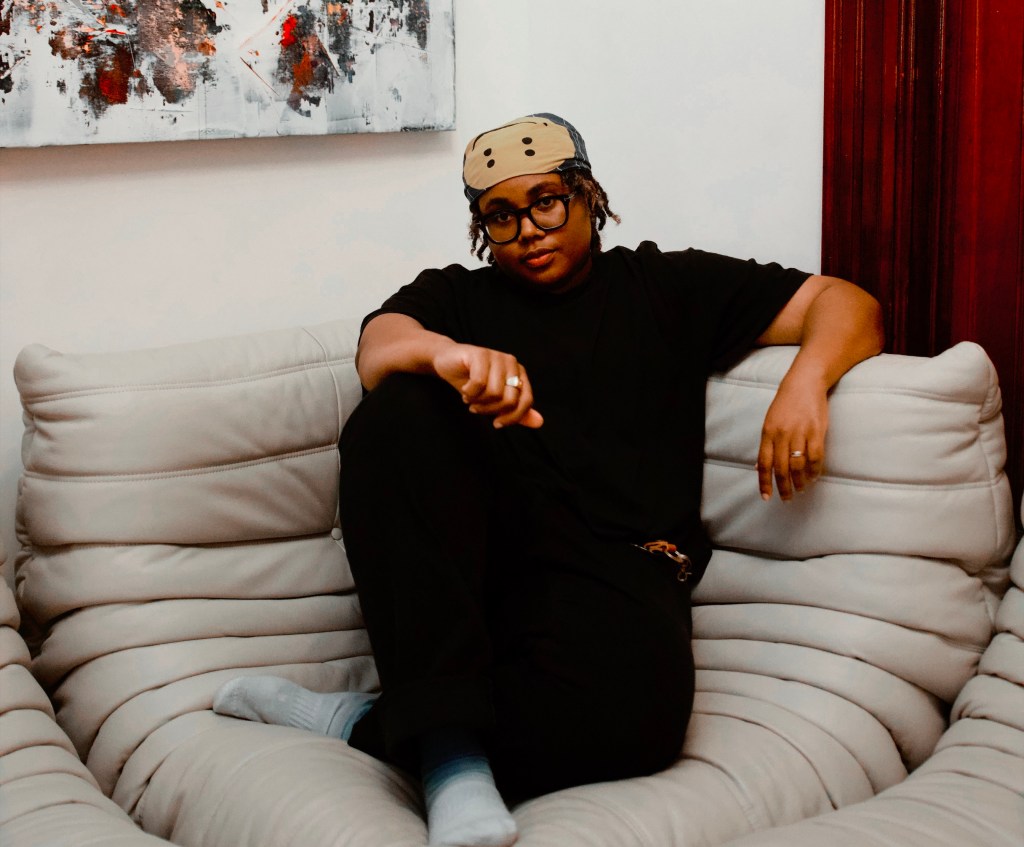
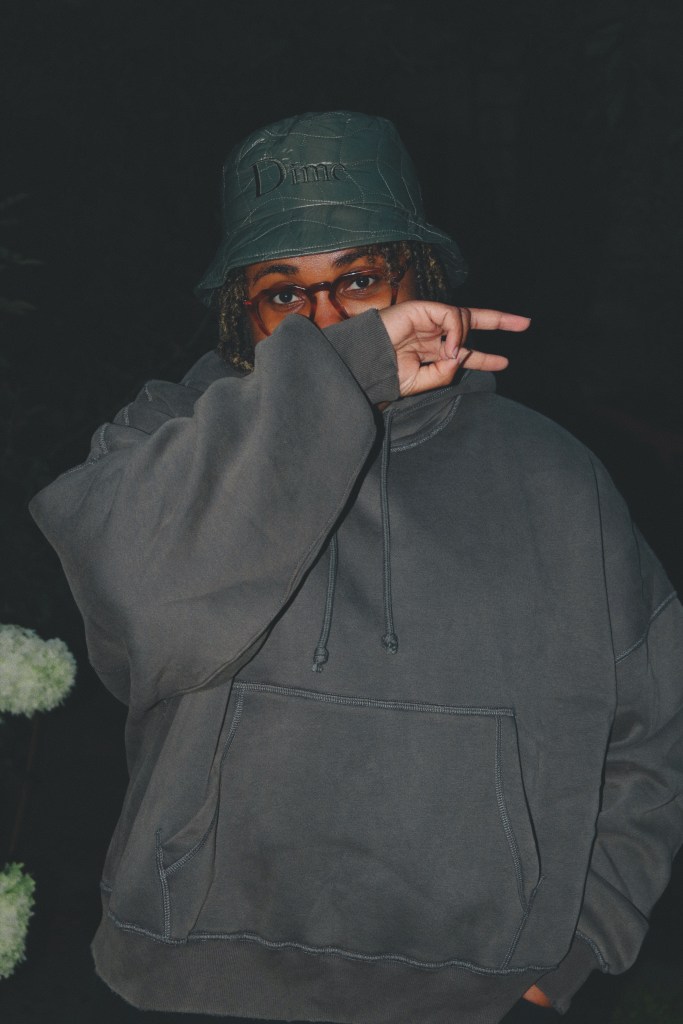
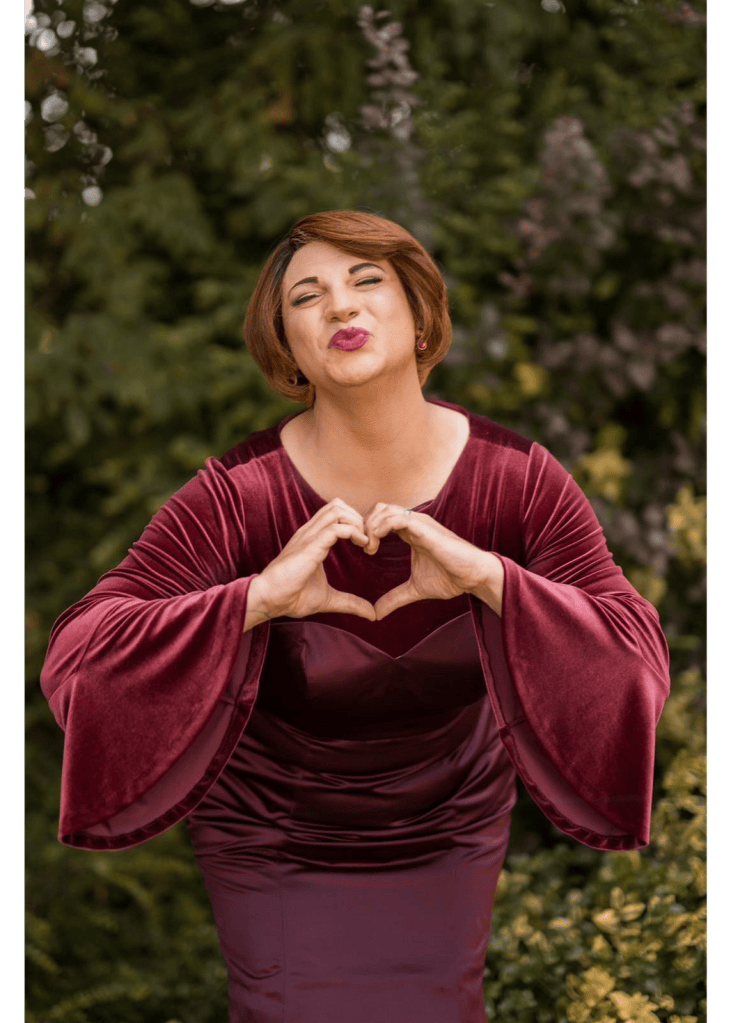
In one of my recent photo projects, I am standing in a black velvet high-neck cropped top with built-in gloves and fuzzy glasses, with photographs of myself covering the rest of my body. Different poses, different expressions, different versions of me are everywhere. It is excessive. Maybe a little narcissistic, but definitely intentional.
To understand why I wanted to literally wear myself, you first have to understand Zortifa.
My last name is Sorto. Growing up in a Salvadoran family, I learned that a family name could carry weight. There were expectations around what a son was supposed to look like, how he was supposed to act, and who he was supposed to become. But I also grew up hearing homophobic remarks from family, from people I loved, and from the culture I was learning how to exist within.
As I got older, I realized I did not want becoming a successful son to mean becoming somebody I did not recognize.
So I started changing things. I got piercings. I highlighted my hair. I grew it out and curled it. I wore fake hazel contacts because I liked the way I looked in them. I started using makeup to cover my rosacea. None of those things alone were some grand act of rebellion, but together they meant something to me. I was learning that I could participate in creating myself.
Somewhere in that process, Zortifa appeared.
The name still holds onto Sorto, but the ending sounds feminine to me. I liked that. Zortifa became a way of keeping where I came from while changing what I believed I was allowed to become. It felt like I was taking my last name and reshaping it into something that could actually hold more of who I was.
Elwim is not Zortifa, but Zortifa is Elwim.
Zortifa is louder. More exaggerated. More fearless. Zortifa is willing to play with femininity and masculinity without sitting there asking which one I am technically allowed to do. There is something almost like drag in it for me, not because I consider Zortifa a drag character, but because there is a performance involved. Sometimes performance gives you permission to express something that was already there.
The kindness in Elwim is still there. So is the insecurity and that little thought in the back of my head wondering what somebody else might say when I walk into a room.
Zortifa just gives those thoughts less authority.
Sometimes I describe it as feeling like myself without contamination. By contamination, I mean the expectations, shame, family roles, ideas about masculinity, and other people’s opinions that can get mixed into the way we understand ourselves before we even get the chance to decide who we are.
That does not mean Zortifa fixed everything.
Sometimes I wonder whether I know Zortifa better than I know Elwim.
I came out in my late teens, and Zortifa has really grown with me in my twenties. Part of me knows this confidence probably developed because I did not always feel affirmed for who I was growing up. When something helps you survive, it can become difficult to imagine who you are without it.
Maybe that is why putting the piece together felt more emotional than just mounting a bunch of pictures of myself onto a board.
Covering myself in photographs became almost like building a shrine to confidence. Some are polished. Some are strange. Some never made it onto Instagram. They are not all perfect, but together they helped construct the person standing in the photograph now.
The glasses cover part of my face, but I am still the lens through which I see my own life. The fuzzy textures feel luxurious to me. The velvet feels delicate, because I am delicate too. I do not think delicateness has to cancel out power.
And yes, there is ego involved.
I think sometimes we are taught to be embarrassed by openly liking ourselves. Too much confidence becomes narcissism. Too much sexuality becomes inappropriate. Too much femininity becomes a problem. Too much of anything becomes something other people feel entitled to correct.
I spent enough time feeling like I was not enough. I am interested now in what happens when I allow myself to be too much.
That has changed the way I approach photography too. I used to wonder whether a setting was beautiful enough for a picture. Now I ask something different. Does the background create the aesthetic, or can I?
I can take a picture next to a trash can and still eat.
Sometimes I do not need the background. The background needs me.
Art is subjective. I do not have to wait for a photographer, an editor, or somebody with more authority than me to decide that I am worth looking at. I can control the pose. I can control the movement. I can decide which photograph feels beautiful, strange, ugly, sexual, funny, or interesting.
I am an artist.
I can be my own muse.
That does not mean I think everything I create is perfect. Sometimes I like the shot a photographer might throw away. Sometimes beauty comes from what an image makes me feel rather than how closely it follows somebody else’s rules.
Lady Gaga has always inspired me for a similar reason. She did not become interesting by recreating everything the world already had. She created something that felt like her. I think we are put into boxes so easily that eventually we stop noticing the walls.
I have already broken out of a few of mine.
I am part of the first U.S.-born generation in my Salvadoran family. I was the first in my family to graduate high school and the first to earn a college degree. I became a veteran. I earned my master’s degree, and now I am working toward a doctorate.
I feel iconic saying that.
Not because I think I am better than anyone else, but because the younger version of me did not always know whether being fully himself and becoming successful could exist at the same time.
Now I know they can.
Zortifa gives me confidence, but they also leave me with questions. How much of Zortifa is armor? How much is art? How much is simply me? Will there ever be a version of Elwim who does not need to perform confidence first?
I do not know yet.
Maybe I am not supposed to.
For now, I can look at that photograph and see all of those versions of myself attached to one body. Masculine, feminine, insecure, confident, soft, sexual, strange, successful, unfinished.
They are all Zortifa.
They are all Elwim.
Becoming my own muse was never really about inventing someone better than myself. It was about finally giving every version of myself permission to exist. Giving myself permission to exist.
Justy, an independent queer artist, makes music at the intersection of alternative R&B, indie soul, jazz, and hip-hop. With her new single, “Traer(te) la luna,” set to be released on August 28, we were eager to ask about her musical inspirations and how she expresses queerness through song.
10 Questions with Justy
You’ve said that your upcoming single, “Traer(te) la luna,” which roughly translates to “Bring you the moon,” highlights the impossibility of giving someone everything because of how they feel. Do you feel queer individuals are more uniquely susceptible to this feeling of impossibly high standards–in life, romance, love–than straight counterparts?
That’s a great question. I don’t think impossibly high standards are exclusive to queer people, but I do think queer people can experience them in a very specific way. Many of us grow up without seeing our love reflected back to us, so when we finally find someone who makes us feel understood, that connection can carry an enormous amount of weight. It can feel rare, almost miraculous, and that rarity can make us want to preserve it at any cost.
“Traer(te) la luna” lives inside that feeling. It’s about wanting to offer someone something as impossible as the moon because ordinary gestures no longer seem big enough. But underneath that devotion is the realization that love cannot always overcome timing, fear, circumstance, or the way someone feels. You can give someone your patience, your vulnerability, and every version of the future you imagined, but you cannot love them into being ready.
For me, that is where the song becomes especially connected to queer love: not because queer people love more intensely than anyone else, but because our relationships can carry the additional pressure of scarcity, secrecy, delayed discovery, or feeling like we have finally found something we were once told was impossible.
Your work crosses multiple different genres–alternative R&B, indie soul, jazz, and hip-hop. What gravitates you towards a specific genre, and how, as an artist, are you able to find harmony between these multiple genres within a song or album?
I’m usually drawn to a sound based on what the story needs. I don’t enter the studio thinking, “This has to be an R&B song” or “This needs to sound like jazz.” Sometimes an emotion calls for the warmth of live instrumentation and jazz chords; sometimes it needs the intimacy of indie soul, the rhythm of hip-hop, or the freedom and atmosphere of alternative R&B. Genre becomes another part of the language I use to communicate.
Finding harmony between those influences feels natural because they all shaped the way I hear music. I grew up loving artists who refused to stay in one lane, from Lauryn Hill and Amy Winehouse to J Dilla, Noname, and Anderson .Paak. Their work showed me that contrast can create cohesion when the artist’s perspective remains consistent.
Across a song or album, my voice and storytelling are the connecting threads. The production may move between genres, but the emotional world stays intact. I’m not trying to make different styles compete with one another. I’m interested in the place where they meet and become something that feels distinctly mine.
How have your experiences as a lesbian artist shaped the themes and ideas within your works?
Before I had the language or confidence to express who I was, songwriting became a place where I could explore desire, uncertainty, intimacy, and identity honestly. That is why so much of my music lives in the space between what we feel and what we are able to say.
I want to write about more than the struggle to be accepted. Queer people also experience so many facets of life that we don’t have nearly enough forms of representation for. Those stories deserve to exist without always needing to explain or defend themselves.
At the same time, I understand the importance of being visible. I did not always see people who looked or presented like me occupying space in the genres I loved. By writing openly from my perspective, I hope another queer person can hear my music and recognize that their love, vulnerability, and contradictions are worthy of being documented.
Every project I’ve dropped, from my debut [album] Pain With Benefits to now, aims to be a transparent representation of my experience.
Who have been some of the greatest queer inspirations in your own artistic endeavours?
Some of my greatest queer inspirations are Syd, CHIKA, Joy Oladokun, Arlo Parks, and Orion Sun. I’m inspired by the honesty in their work, the individuality of their sounds, and the different ways they represent queer experiences through music. Each of them creates without being limited by genre or expectations, while remaining authentic to who they are. Seeing queer artists take up space and build meaningful careers has encouraged me to trust my own perspective, experiment with my sound, and create the kind of honest representation I would have valued when I was younger.
You focus on queer tenderness in your works. Why do you think it’s important to look at queer tenderness specifically in art?
I think queer tenderness is important because queer stories are often framed around struggle, rejection, or the need to fight for acceptance. Those stories are real, but they are not the entirety of our lives. We also experience softness, safety, longing, quiet intimacy, and the feeling of being fully understood by another person.
Focusing on tenderness allows me to show queer love as something expansive and deeply human rather than something that must always be explained through conflict.
Did your musical journey work in tandem with your own understanding of your sexual orientation, or did one clearly begin before the other?
I would say so. For me, making music was discovering parts of myself that didn’t have space to live comfortably. When I started creating, I felt I could finally connect with thoughts that had been building within me. It almost felt as if my identity was flourishing as I continued to lean into my writing process and musicality.
Along with utilizing multiple genres, you also use multiple languages in your works, such as English and Spanish. How has working with multiple languages shaped or changed your songs?
“Traer(te) la luna” is actually the first song where I’ve worked with multiple languages. Collaborating with Kiki Corona and bringing Spanish into the song opened up a new emotional and musical dimension for me. Some feelings take on a different texture when expressed in another language, and Kiki’s contribution allowed the tenderness and longing at the heart of the song to come through organically.
The collaboration also made me think beyond the literal meaning of each line and consider how language affects a song’s rhythm, tone, and emotional weight. The Spanish does not feel like a separate addition; it is central to the atmosphere and identity of the track. Working with Kiki showed me how collaboration and language can expand not only what a song communicates, but also how deeply it can be felt.
Can you offer some details about your artistic process and how you create a song that is so uniquely Justy?
My process usually begins with a feeling, a phrase, or a chord progression that stays with me. I tend to write from emotions I have not completely worked through yet, so the song becomes a way of discovering what I am actually trying to say. I’ll record melodies and scattered lyrics in my voice notes, then slowly build the story around the lines that feel the most honest.
Production is also an important part of my writing. I naturally pull from jazz, hip-hop, neo-soul, and alternative R&B.I love warm chords, layered vocals, conversational lyrics, and small details that make a song feel intimate and lived-in.
What makes a song uniquely Justy is probably that balance between honesty and restraint. I’m interested in the things people feel deeply but do not always say aloud. I try to leave enough space in the music for listeners to place their own memories and experiences inside it.
Have you felt pressured to change or alter your work to reach larger audiences? And what do you say to people who may themselves feel pressured to change themselves to accommodate heteronormative standards with art?
There is always some pressure as an independent artist to make your work easier to categorize or more comfortable for a wider audience. For queer artists, that can also mean feeling encouraged to make lyrics less specific, avoid pronouns, or present ourselves in a way that fits someone else’s idea of what is marketable. Earlier in my journey, I sometimes kept parts of my writing intentionally vague because I wanted everyone to relate to it. Over time, I realized that specificity does not make a song less universal. The more honest I am, the more people seem to find themselves in the music.
To anyone feeling pressured to accommodate heteronormative standards, I would say that you do not have to dilute yourself to make your art meaningful. There is no single correct way to create queer art, and you should never feel obligated to disclose more than feels safe. But when you are ready, trust that your perspective is not an obstacle to connection. It is often the very thing that makes your work memorable. The goal is not to make yourself smaller for an audience; it is to create honestly enough that the right audience can recognize you.
What would you like to see listeners take away from your work, and especially listeners within the LGBTQ+ community?
I want listeners to feel understood. My songs often explore emotions that are difficult to say aloud, such as longing, uncertainty, vulnerability, and the stories we create around the people we love. Even when a song comes from a very personal experience, I hope listeners can place their own memories inside it and find language for something they have felt.
For LGBTQ+ listeners specifically, I want the music to feel like a space where their love is allowed to be tender, complicated, ordinary, and fully human. Queer stories do not always have to center on trauma or explain themselves to others. We deserve songs about crushes, mixed signals, romance, heartbreak, and all the quiet moments in between. If someone hears my work and feels less alone, more visible, or more comfortable embracing their own softness, then the song has done what I hoped it would do.
“Traer(te) la luna,” Justy’s new single is described as “A dreamy bilingual indie soul / alternative R&B record about the space between attraction and imagination. Moving between English and Spanish over warm guitars and jazz-influenced production, the song captures the beautiful irrationality of wanting someone so much you’d give them the moon.” The single will be available on all music platforms on August 28.
There is a question running beneath all of Jake Robertson’s work: What is it that makes us human, and what happens when someone tries to take that away?
Robertson (They/He) is a Soviet cultural historian, educator, theatermaker, and storyteller. They studied Slavic Languages and Literatures at Princeton, trained in acting at the Royal Conservatoire of Scotland, and recently completed a PhD at Oxford, where they researched professional theater inside Soviet Gulag camps.
But Robertson’s work has never been confined to the archive. They have taught Russian language, history, and theater to students around the world. Robertson’s scholarship examines the relationship between artistic expression and political control, exploring how culture survives and sometimes resists under authoritarian systems.
At the same time, Robertson’s career as a theatermaker and drag artist has taken him from Off-Broadway theaters to queer pubs to Shakespeare’s Globe.
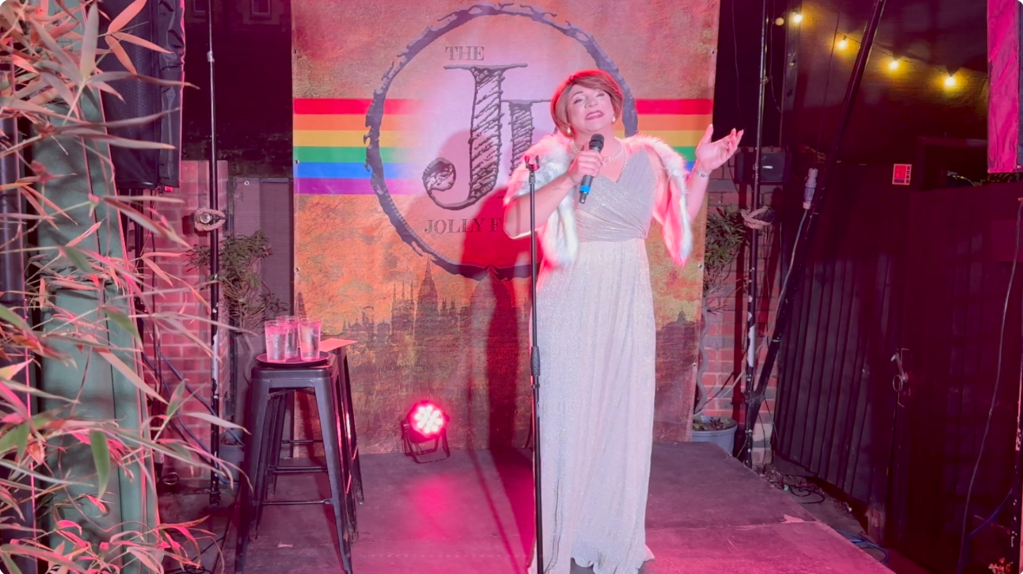
Robertson’s creative projects include Saundra Lezzenbaum: Love in Concert!, a one-woman drag spectacular combining original music, improv comedy, and couples therapy. Love in Concert! was just one of Saundra’s shows. Her current rep is a monthly community mixer called Saturday Night Love. It also combines comedy, cabaret, and group therapy in an effort to foster connections and build community.
There is also Songbird, a play in development that weaves together the life and music of queer Soviet cabaret icon and Gulag theater star Vadim Kozin with the story of a drag artist facing imprisonment in contemporary Russia.
On paper, these worlds might seem impossible to reconcile. An Oxford historian and drag performer. Soviet archives and comedy clubs. Gulag theater and queer performance. But for Robertson, they are all part of the same lifelong inquiry.
“What binds us all together, while at the same time making us wholly unique?”
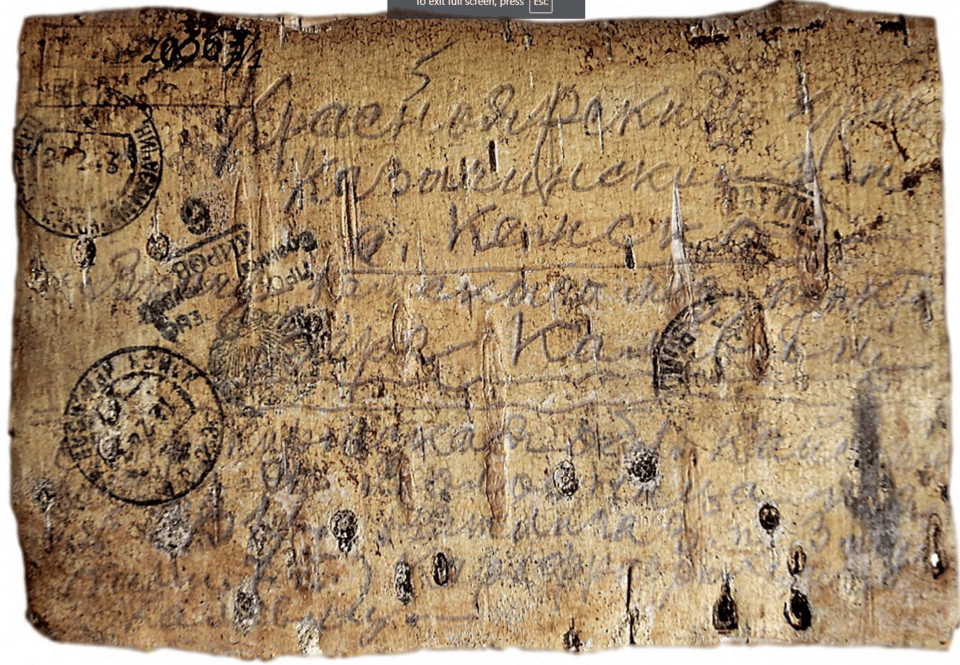
Birch bark letter from Siberia.
The Search for What Connects Us
Robertson’s fascination with humanity has always existed between individuality and belonging.
For much of Robertson’s early life, they carried the weight of a divided identity. They describe spending two decades closeted, negotiating questions about who they were and how openly they could live.
“I began as a nerdy sensitive gay boy in the Midwest and now have broken out of the binary and embrace an expansive queer identity that transcends gender and sexuality, shaping my perspective on almost everything,” Robertson says.
“Now that I have embraced who I am and opened that up more and more, I have become even more interested in bringing us together and what we all share.”
Whether sitting in an archive in Siberia researching a forgotten performer, or stepping onto a stage as Saundra Lezzenbaum, Robertson keeps returning to the same essential human longing. To be recognized.
“There is something magical that happens when you can be seen by someone else,” Robertson says. “We are vast and complex, but in some profound way, we want to be seen.”
For Robertson, that recognition carries almost spiritual weight.
“Namaste,” comes to mind. “The divine in me sees the divine in you.”
That belief may seem far removed from the brutal realities of Soviet repression, but Robertson sees the same human impulse everywhere: the desire to connect and find meaning even in circumstances designed to destroy those possibilities.
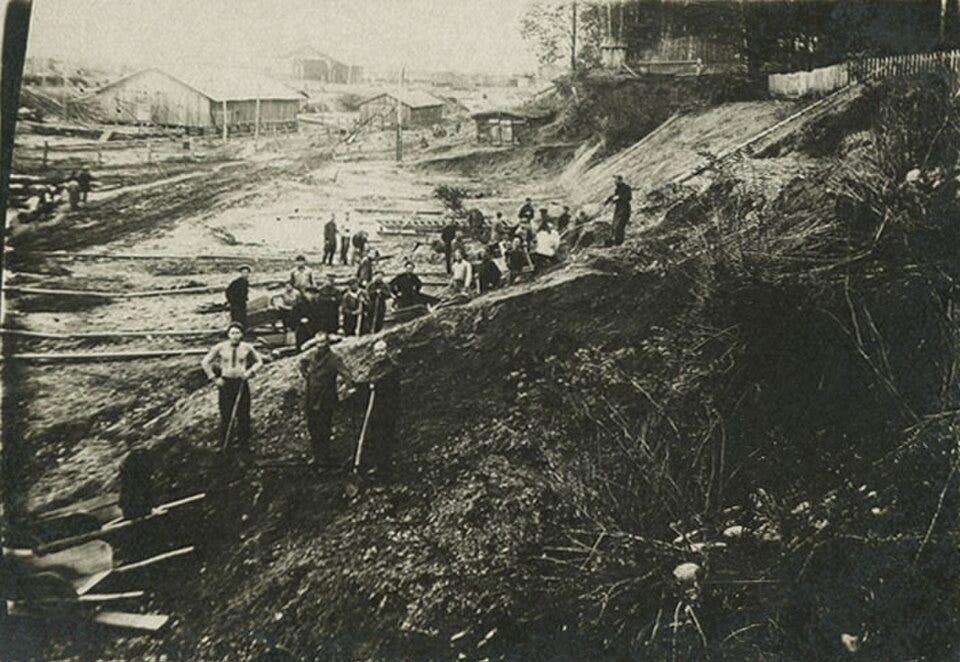
Gulag work.
The Stage Behind the Barbed Wire
Robertson’s doctoral research examined one of history’s most unlikely artistic landscapes: professional theater inside the Soviet Gulag.
The Gulag system was built around forced labor and political control. It was designed to extract productivity from millions of prisoners while attempting to reshape them according to Soviet ideology.
Yet within that system, something unexpected emerged: Theater.
“I got into Gulag theater through memoirs,” Robertson says. “Through these experiences in the camps, I felt this connection to the artists.”
Prisoners who had been actors, directors, musicians, and designers before their imprisonment continued creating. Others found artistic roles within the camps. They built stages, organized performances, designed sets, and produced operas and plays, all while receiving the support and resources of local Gulag administrators.
Within the very system that sought to destroy their humanity, these artists found a way to preserve that humanity through their art.
For Robertson, this transformed his understanding of creativity.
“As a theater maker and a creative, it gave me a deeper reverence for the creative act as an expression of your identity…There is something about revering that act.”
Art was not simply entertainment but proof of existence. It was a declaration.
I am still here.
Robertson’s research also complicates easy narratives. Gulag theater was not simply a story of heroic resistance. The performers often faced impossible moral questions. Some felt guilty because theater offered them privileges unavailable to others. Some prisoners accused them of collaborating with camp authorities.
“The people who survived,” Robertson explains, “are the ones whose memories we are reading.”
History, like humanity itself, is complicated.
“That spectrum of humanity and barbarity is fascinating… The same camp boss who took up the role of patron-of-the-arts, who joyously cheered for the Gulag opera, also oversaw a regime of mass starvation, exploitation and death.”
The contradiction is unsettling. But it is also revealing. History does not only show us what people do. History forces us to contemplate the contradictory vastness of being human.
Robertson’s dissertation will be a book set for release in 2028 with Cornell University Press.
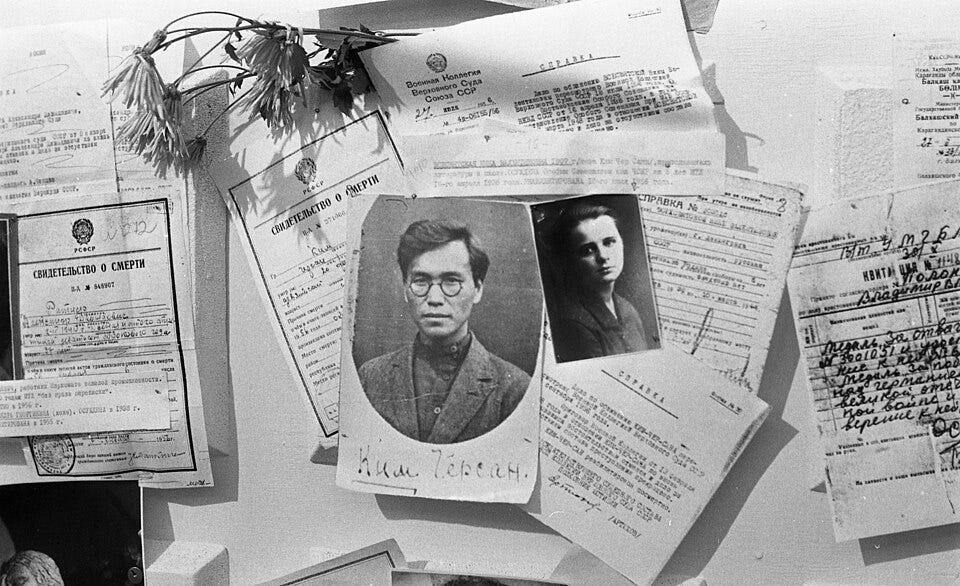
Documents of the Gulag’s victims.
Why Authoritarians Fear Stories
For Robertson, the struggle over history is ultimately a struggle over storytelling.
“Stories were everything. All human institutions and civilizations are built around stories.”
Governments use stories to create national identity, justify policies, and define enemies. The Soviet Union carefully constructed narratives about progress and the inevitable triumph of communism.
But stories are dangerous because they can never be fully controlled. They can also complicate official narratives.
“I believe official narratives are also a form of storytelling, and a powerful one at that. But our stories, especially those that illuminate the expansive complexity of human reality, can also serve as an incisive challenge to those hegemonic discourses. That to me is the power of queer stories, the kind that refuse to submit to norms, conventions and binaries.”
Authoritarian systems often demand simplicity: one truth, one version of history, one acceptable identity. But human experience resists simplicity.
“Reality is more complex,” Robertson says. “That complexity is exactly what my work seeks to preserve.”
“The story of Gulag theater would have been lost to the snowdrifts of time were it not for the local historians, survivors, descendants who preserved those memories and materials. My goal with my decade of research was to do my part to make sure they did not die and disappear.”
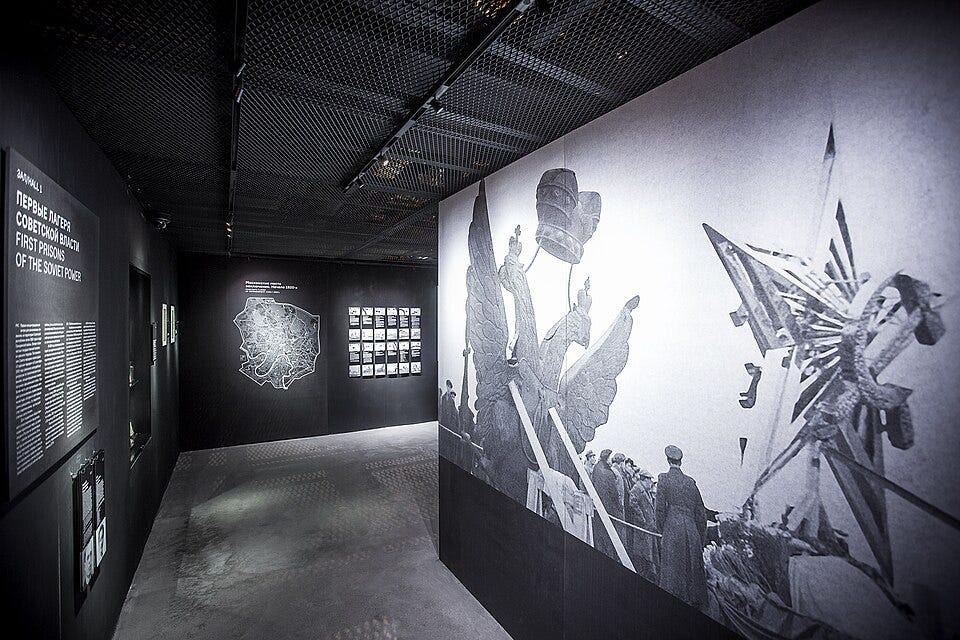
Exhibition of the GULAG History Museum.
Historians are trained to analyze evidence carefully. Artists are trained to explore possibility. Robertson believes both are necessary and mutually enriching.
“I have years of training as a serious historian and as an artist. There is something to be said about the reality and limits of our knowledge, understanding what we can and cannot know for certain.”
But scholarship cannot remain locked away.
“It can’t exist in a vacuum. We need to communicate what we learn and share it.”
At NYU, Robertson went on to create a brand new multidisciplinary course on Soviet Theater. It was called “Soviet Stages: Theatre as Revolution, Repression & Resistance in the USSR.” This fall, they will teach Introduction to Theatre Studies, building the course around the frame of drag and performing gender onstage and off.
“When we did the scenes in class, we learned much more,” Robertson says, reflecting on Soviet Stages. “We could never get that just from words on a page. The artist enlivens and brings to life so many new things that we cannot do as researchers.”
That philosophy informs Saundra Lezzenbaum, Robertson’s drag persona.
Saundra Lezzenbaum is a fictional character, drag cabaret persona, and self-proclaimed “America’s Queen of Hearts” whose larger-than-life mission is to rescue romance one laugh at a time. Hailing from her “palatial duplex in Ronkonkoma, Long Island,” Saundra presents herself as a world-famous love coach, matchmaker, and relationship expert whose improbable résumé includes a cosmetology background, a lunchtime Emmy-winning television show called Queen of Hearts on The CW, and a collection of wildly imaginative self-help books, including Married to Menopause: Keeping Things Hot Through the Hot Flashes and her love memoire Heart Attack, the Good Kind.
At the center of her carefully crafted mythology is her supposedly flawless marriage to her beloved husband, Max Lezzenbaum, which she uses as the foundation for her advice on achieving “#PerfectMarriage” bliss. In performance, Saundra becomes a comedic Cupid for the modern age, hosting interactive New York City mixers, cabaret shows, and variety events aimed at solving what she jokingly calls the city’s “Cost of Loving Crisis.”
Through her one-woman musical comedy spectacular Love in Concert!, featuring original parody “Saungs” from her fictional album Saungs for a Perfect Marriage, and her audience-driven “Love Lezzons,” where she improvises relationship advice based on real dating dilemmas, Saundra blends satire, theater, and audience participation into a joyful exploration of love and the absurdities of modern romance.
For Robertson, drag is not an escape from serious scholarship. It is another form of historical inquiry. A way of asking: Who gets to be visible and who gets to imagine another version of themselves?
“By doing drag as a community mixer, it combines celebration of individual identity with a commitment to bringing us together and building real human connection.”
Remembering People Well
Robertson’s projects repeatedly return to forgotten voices.
His genealogy project, Ancestory, transforms family history into narrative experience. It asks people to confront their ancestors honestly, not as perfect heroes or permanent villains, but as complicated human beings shaped by their circumstances. Ancestory weaves together rigorous archival archeology and inspired people-centered storytelling, fostering an accessible personalized journey through your family tree. This unique ancestry experience is curated by Robertson.
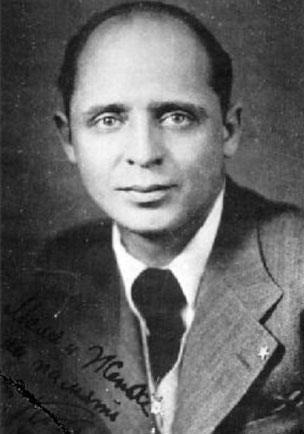
The play Songbird continues this work by exploring the life of Vadim Kozin (1903–1994), a queer Soviet cabaret icon whose career was transformed by Stalinist repression. Known as the “Soviet tango king,” his powerful, lyrical voice blended traditional Russian romance with gypsy soul.
In 1944, at the height of his fame, Kozin suddenly vanished from public life. He was arrested by the Soviet secret police and charged with homosexuality, which was criminalized under Joseph Stalin’s regime. Convicted and sentenced to hard labor, Kozin became the star of the Gulag Theater of Magadan.
The details shift but the mechanisms remain. The attempt to silence certain identities is an attempt to decide whose lives are worthy of recognition.
Vadim Kozin
Near the end of our conversation, Robertson considers a thought experiment: What if tomorrow every archive disappeared? Every book. Every historical document. Every official record. What would remain?
Human storytelling.
What stories would they fight hardest to preserve?
The stories of connection and creativity. The stories of people who found ways to remain human in the face of inhuman circumstances.
“I guess what comes to mind,” Robertson says, “is that there is something in us all that connects us.”
A historian might hesitate because such a statement is difficult to prove. But Robertson has spent their life witnessing it. In Soviet archives and on theatrical stages. In classrooms and in moments of performance and vulnerability.
“There is something that does unite us at our core. And it can be seen by people of vastly different experiences.”
Perhaps that is the thread running through everything Jake Robertson does.
The historian searches the past for forgotten voices. The teacher shares knowledge across cultures. The storyteller preserves complexity. The performer creates spaces where people can be fully seen. And beneath it all is a belief that may be the most radical story of all: Even in the darkest places, human beings continue creating. They continue connecting. They continue telling one another:
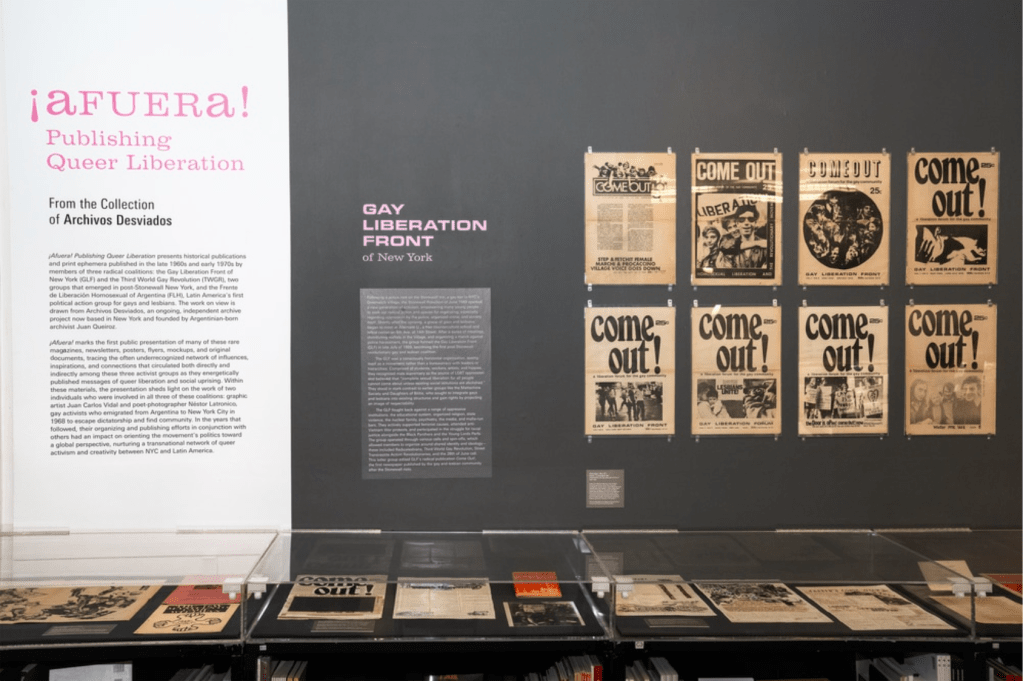
The Queerest attended Printed Matter’s exhibition ‘¡Afuera!: Publishing Queer Liberation’ at its 13th annual LA Art Book Fair, which took place from May 7 to 10, 2026, at ArtCenter College of Design in Pasadena, California.
¡Afuera! marked the debut L.A. exhibition of several historical publications and print ephemera published in the 1960s and 1970s by members of three radical coalitions: New York’s Gay Liberation Front (GLF) and Third World Gay Revolution (TWGR), and Argentina’s Frente de Liberación Homosexual of Argentina (FLH). The exhibition’s rare posters, flyers, newsletters, and magazines shed light on the organizing and publishing efforts of a network of determined social, political, and cultural activists of the era.
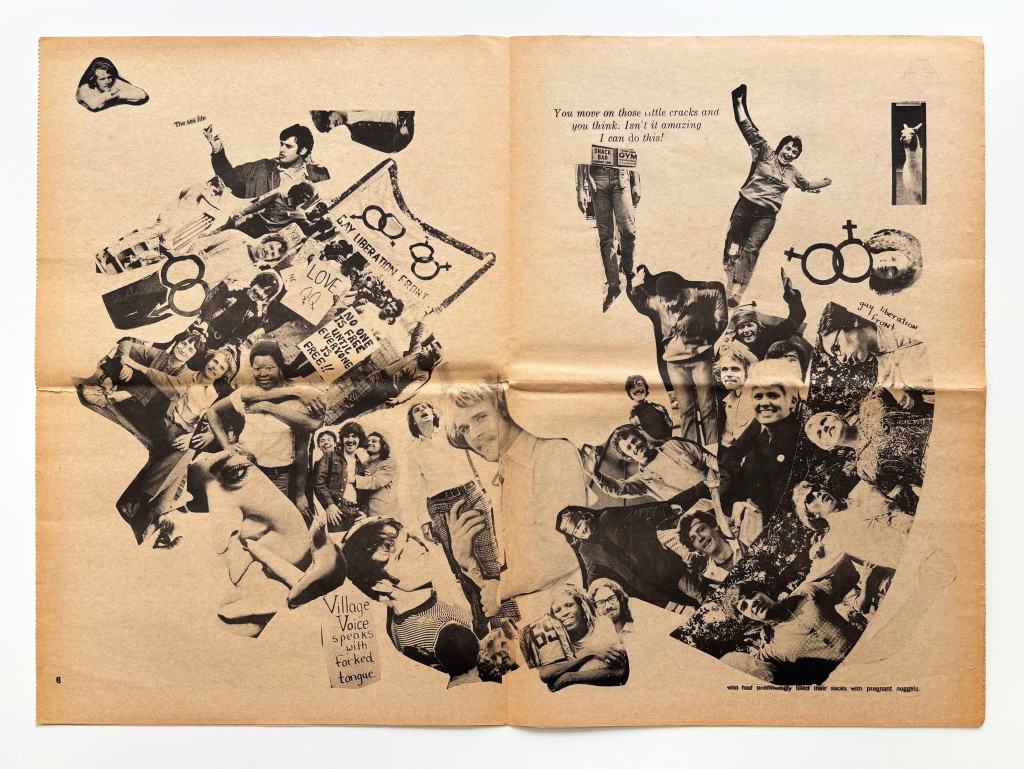
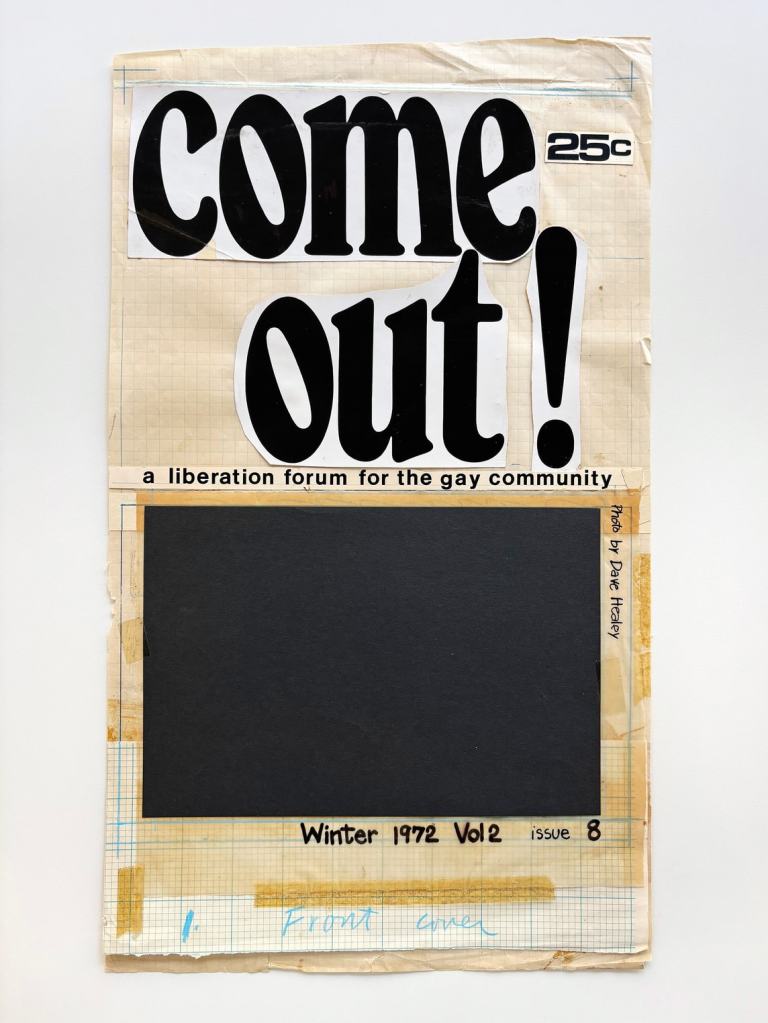
¡Afuera! highlights the work of graphic artist Juan Carlos Vidal and poet-photographer Néstor Latrónico, gay activists who emigrated from Argentina to New York City in 1968 to find a new community. Vidal and Latrónico collaborated on illustration and graphic design for the GLF’s newspaper, Come Out!, and for the FLH’s publication Afuera and its bulletin Somos. Examples of their publications, including all issues of Somos and a mock-up cover of Come Out!, were on display.
Vidal and Latrónico used visually striking, often colorful publications to draw attention to their queer activism and their messages of intersectional liberation, anti-imperialism, and anti-capitalism. The exhibition highlights the role that artist- and community-run printing projects played in sharing resources and information among queer activists in a pre-Internet age.
Original cover mock-up of Come Out! Issue 8, Winter 1972, published by the Gay Liberation Front of New York. Courtesy Archivos Desviados.
The exhibition is drawn from the New York-based collection of Archivos Desviados, which was created by Argentinian-born archivist Juan Queiroz in 2019. The ongoing, independent archive preserves thousands of historical documents from queer movements.
Learn more at printedmatter.org/afuera, and follow Archivos Desviados on Instagram @archivosdesviados.
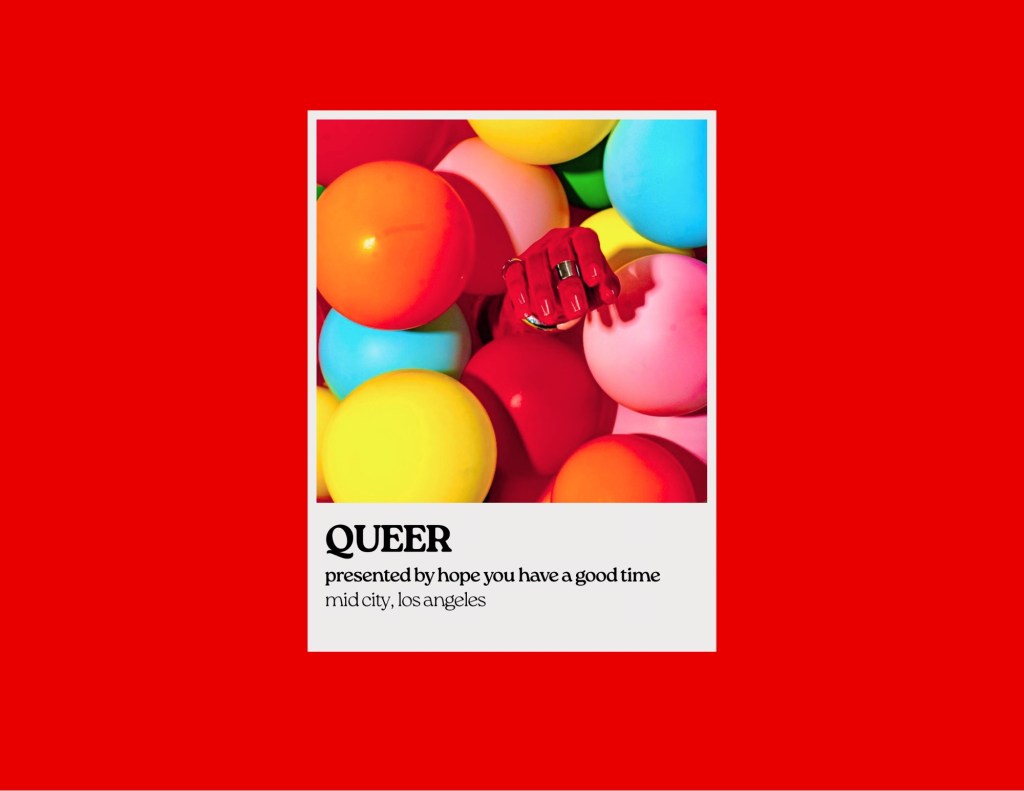
QUEER x hope you have a good time is an art show in Mid-City Los Angeles, bringing together over 20 artists responding to the following quote from Bell Hooks:
“[queer] not as being about who you’re having sex with – that can be a dimension of it – but queer, as being about the self that is at odds with everything around it and has to invent and create and find a place to speak and to thrive and to live.”
HYHAGT × QUEER explores the self at odds with the surrounding world, featuring art installations from 20+ artists, tarot card reading, community art experiences, donation-based drinks, and a DJ set by Emily Alegria.
The marketplace and gallery will be open on May 30th from 5-10pm.
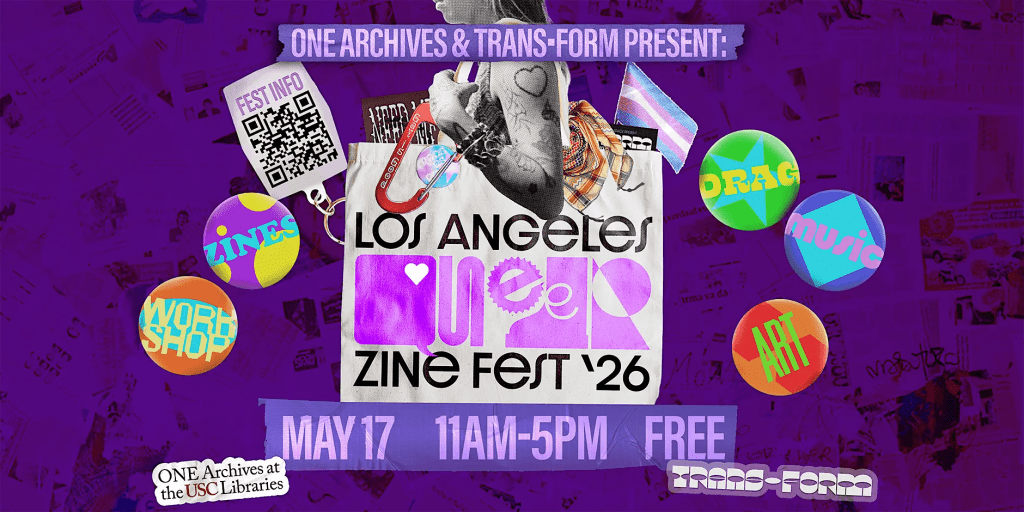
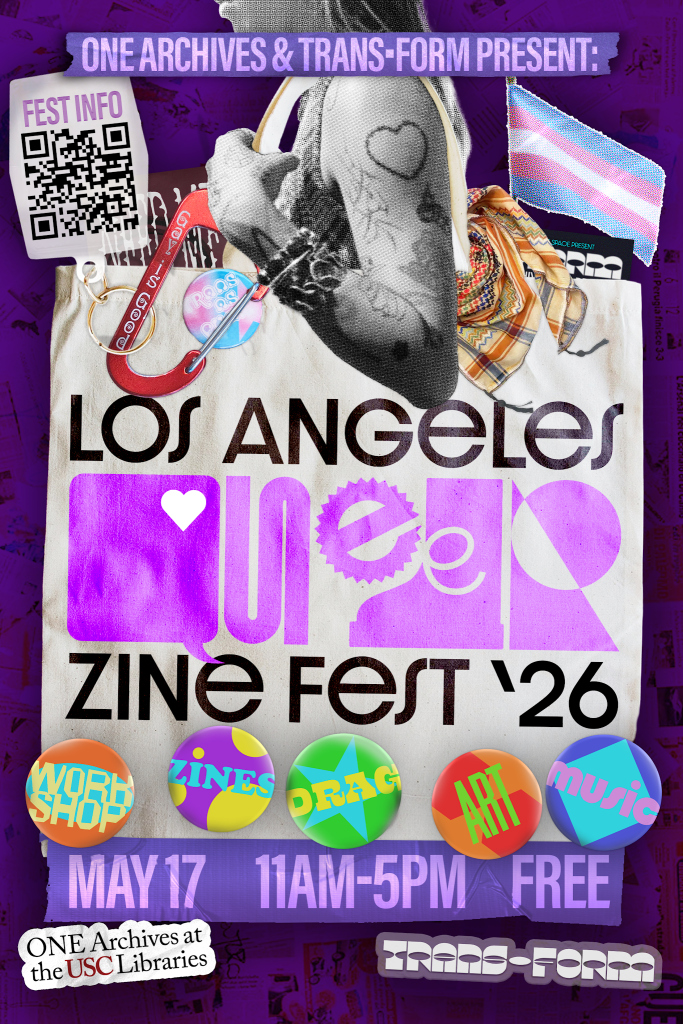
Los Angeles Queer Zine Fest, a one-day celebration of queer and trans zine makers, artists, printmakers, publishers, and performers, is taking place this Sunday at the ONE Archives at the USC Libraries. The event will combine:
(1) 45+ queer and trans-identifying vendors; (2) live drag performances, music, and poetry; and (3) a zine-making workshop.
Per the ONE Archives, zines “have long been a tool for queer and trans people to document our lives, share resources, tell our stories, build community, and create outside of traditional publishing.” Building on this tradition, the L.A. Queer Zine Fest intends to “platform queer voices and encourage participation in the preservation and celebration of queer history.”
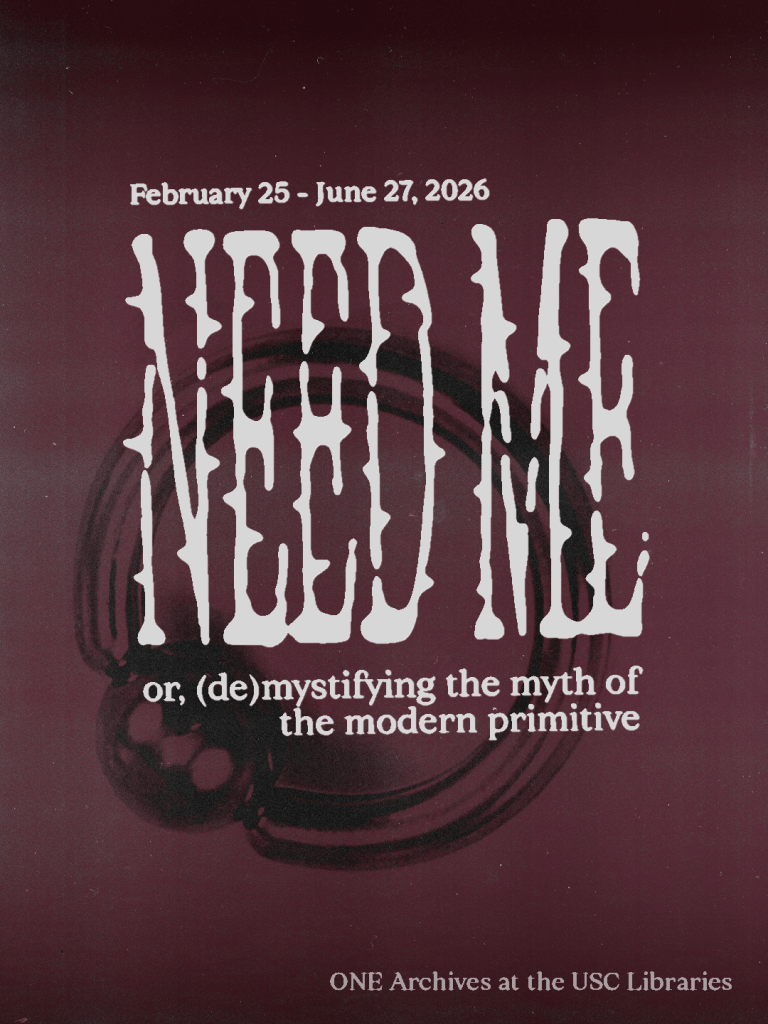
During the 2026 Fest, guests are encouraged to visit NEED ME, or, (de)mystifying the myth of the modern primitive, which is billed as “the first ever public exhibition to present the Western history of body piercing and its roots in queer history.” NEED ME will highlight the artwork and ephemera of queer individuals who were essential to modern piercing history, including Catherine Opie, Ron Athey, Bob Flagan & Sheree Rose, Leigh Bowery, Annie Sprinkle, and Efrain Gonzales.
Founded in 1952, the ONE Archives is the largest repository of LGBTQ+ materials in the world, containing millions of items including art, books, films, videos, audio recordings, and periodicals. The Fest is presented by TRANS•FORM, a growing programming series of workshops, performances, and community events which “creates space in the world for trans people through art, resources, and collective care.” The Fest is free of charge and open to the public. RSVP is not required, but encouraged. The Fest will take place in the ONE Archives parking lot. Public transportation (Metro E Line) is encouraged. Aside from street parking, a paid lot is a 2-minute walk from the Fest.
May 17, 2026, 11 a.m. to 5 p.m. Free ONE Archives at the USC Libraries, 909 West Adams Boulevard, L.A., CA 90007
Growing up, I wanted to dress up as desirable. I wanted to trade in my straight eyelashes for curled ones and change my brown eyes to blue. I wanted to grow four inches in height and lose two around my waist. I yearned for wavy hair that framed my face instead of the stick-straight hair I was given. My eyes were wide enough to see, but not wide enough to be seen. I would have traded them in an instant. When I walked into a room, I wanted people to turn their heads to look at me. I wanted to hear it, the rustling of hair against shirt collars. I wanted the air to shift around me so that the music sounded a little clearer and the drinks tasted a little sweeter. All of this yearning and shapeshifting to be liked by boys. Boys who looked straight through me to get a better glimpse of my friends. Boys who made racist remarks about me as a joke, and friends who let it happen. I knew that the costume I wanted could never be bought online. In a world full of tricks, that was the biggest one of them all.
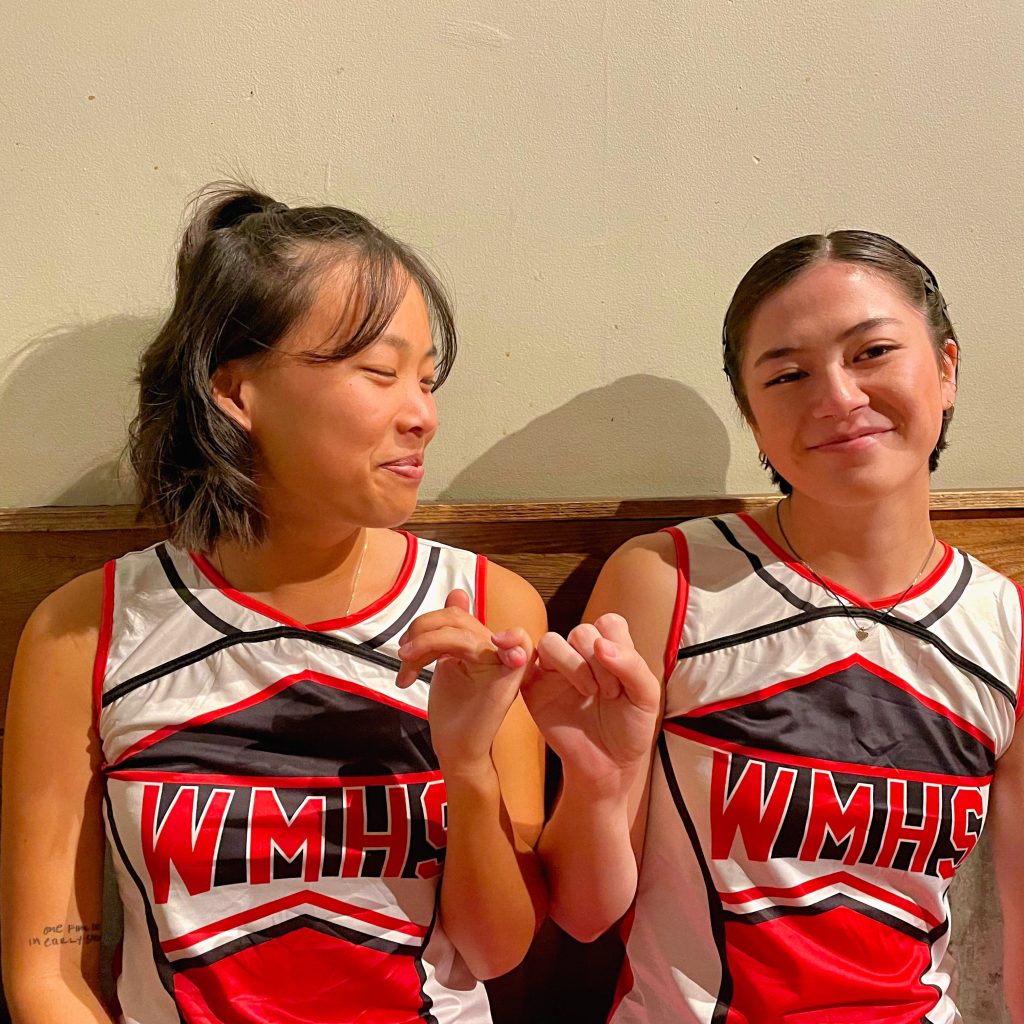
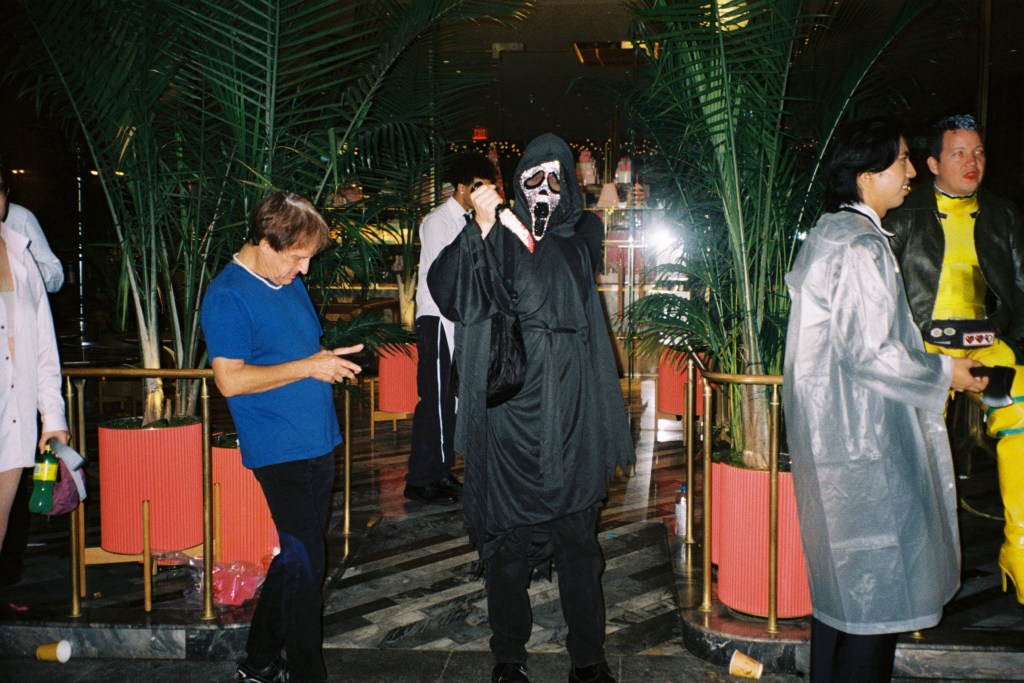
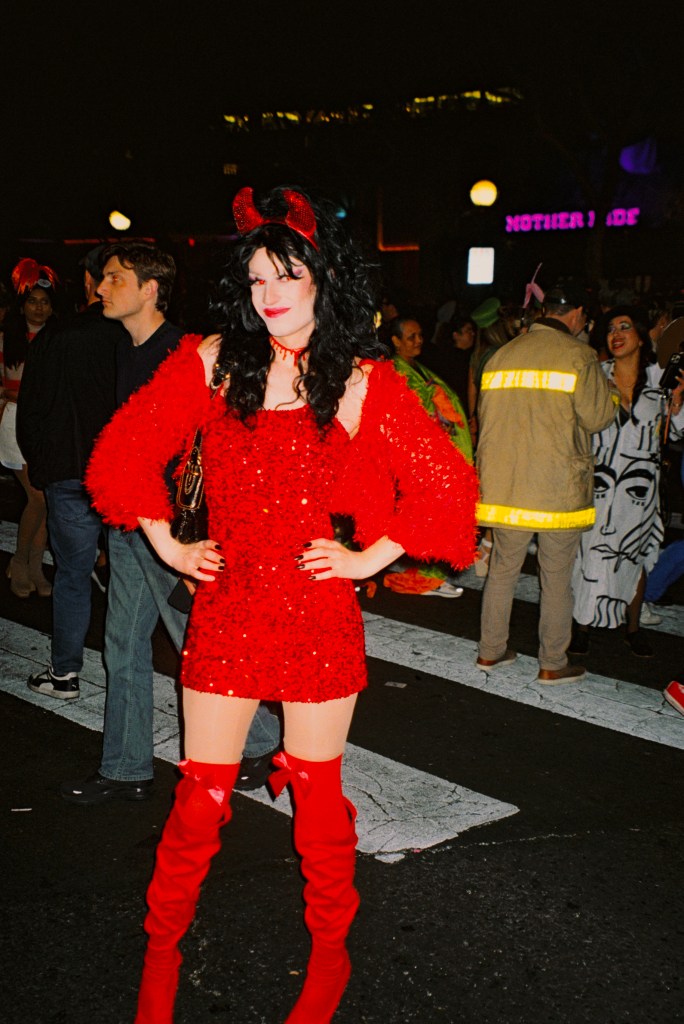
When Halloween rolled around, I was reminded that even on a day where anything was possible, I would never be able to be the one thing I really wanted: an equal. While I didn’t love the holiday, I knew an opportunity when I saw one. Without its quality of childlike wonder, it was a chance to flip expectations on their head. It was the one day a year when the impossible was possible. A nice girl could be a witch and a shy girl could be noticed.
When I fell in love, things began to change. At last, I had caught the feeling I spent my whole life pursuing. The fog of self-loathing cleared, and I looked around, assessing the damage. I was alive, and other than 22 years of mental turmoil, remained mostly intact. I discovered that what made me undesirable was my environment, not me. And I discovered that the feeling I had when I looked at a pretty girl, the one I had almost convinced myself wasn’t real, was, in fact, the thing I had been wanting all along. With this newfound knowledge, I could start over as someone new, someone who dressed up as the character from their favorite childhood movie, for no reason other than for themselves. How strange and wonderful it was to put me first!
Now, Halloween has taken on a new meaning. I no longer have to choose between pleasing others and pleasing myself, because the only person I care about is already next to me, holding my hand. Embracing my queerness helped me to accept many things, some more obvious than others, but I never imagined that a holiday that used to symbolize conformity could return to one of storybook characters and laughter.