Tag: queer movie

  • Pillion Review: When Heartbreak is the Greatest Torture

    Pillion Review: When Heartbreak is the Greatest Torture

    Director and writer Harry Lighton depicts a universal toxic relationship dynamic through the guise of a queer BDSM romance film.

    By Maxwell Fong

    Rating: 5 out of 5.

    After premiering in the U.K. four months prior, I was really looking forward to seeing Pillion with my friend Malik, whom I had not seen since September. He showed up in a T-shirt and jeans, coming directly from work, but also donning his chain and padlock necklace, as well as a drawstring bag with the rubber pride flag embellished on it. When we walked into the theater, we saw others wearing leather jackets and pants from Mr. S Leather. It was evident that this was a much-anticipated movie by the BDSM community.

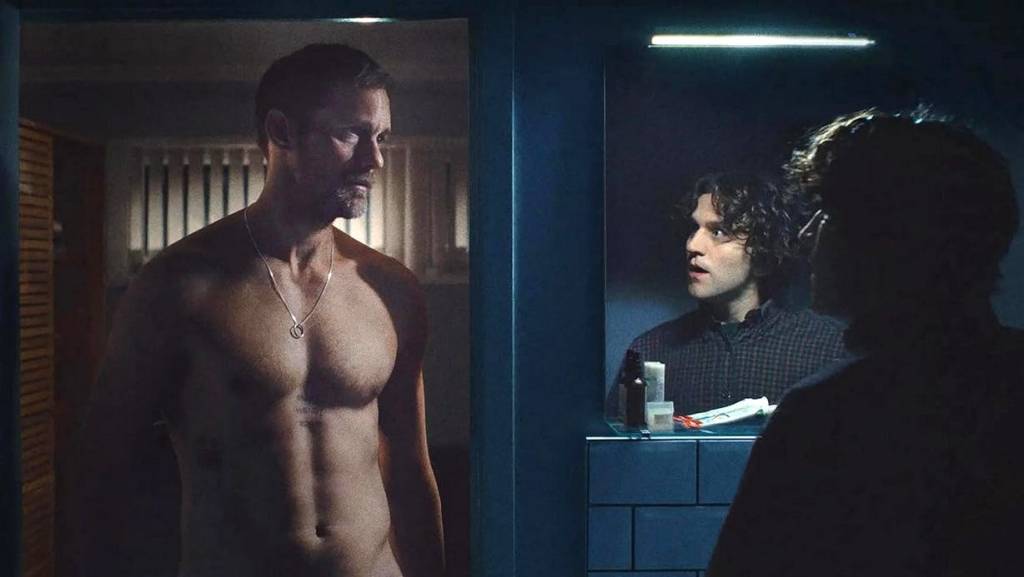
    Pillion is a film adapted by Harry Lighton from the 2020 novel Box Hill by Adam Mars-Jones. Colin (played by Harry Melling), a meek wallflower beloved by his parents, falls head over heels (or leather boots, rather) for Ray (played by Alexander Skarsgård), a prepossessing and possessive biker dom. As Colin comes to actualize his identity and discover his desires, he also has to grapple with his mother being terminally ill and Ray being emotionally unavailable.

    This film was phenomenal and captivating from start to finish. Even though the film was marketed as a “BDSM rom-com”, the story is that of self-discovery at its core, which is told through a toxic relationship presented through a BDSM lens. It is ultimately a story about Colin’s growth as a young queer person and Ray’s inability to open up emotionally. Because the core story works, everything else falls into place and enhances and texturizes the story. The sex scenes and motorcycle jackets (or as Little Mix would call them, “motorbike”) are not just for fluff and theatrics, but rather important turning points for their relationship dynamic. The narrative arcs and character traits are set up perfectly and intentionally, and I loved the pacing of most of the film; the only thing I would nitpick on is how clunky the ending felt.
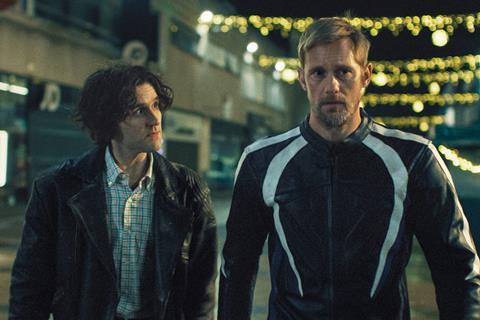
    Both actors were amazing in their roles. Obviously, Melling had the bigger part to play, and the range he showcased alongside the emotional journey of Colin was fantastic, from desperation to grief to rebellion to adoration. To my delighted surprise, Skarsgård was able to convey so many subtle emotions, even as an emotionally constipated, stoic authority. In a sense, Ray is also discovering what he actually wants and needs, like Colin, except he has no emotional resilience. Colin and Ray’s relationship is nuanced and fluid, and not being afraid to dwell in that grey area and blurred boundaries is what makes this film so great.

    This muddy relationship dynamic is one that I have rarely seen encapsulated on film. As a young queer person, Colin’s worldview has been set up by his parents and their understanding of queerness, as evidenced by an arranged date by his mother in the beginning. Ray shows up and opens Colin’s mind (and hole), and eventually goes as far as defending their relationship in front of Colin’s parents, which is my favorite scene of the film. Ray says to Colin’s mom at the dinner table: “Deciding that what makes you comfortable is bad for your son.” On the one hand, Ray is absolutely right in calling her out on conforming her son to her expectations, but on the other hand, Ray is using Colin’s trust and the foil of progressivism to treat him poorly, refusing to tend to Colin’s needs and form a romantic connection. Because of Colin’s people-pleasing character and not knowing any better, he ends up settling for scraps and convinces himself that this is what a relationship looks like. This emotional torture is harder than any boot licking and butt fucking he has to endure.

    As Malik and I walked out of the theater, we both reminisced about past relationships we had when we were younger, where the power dynamics felt extremely similar to that of this film. Right when I turned 20, I dedicated my life to someone 15 years older, only to find out his emotions flipped on a dime, and he was unwilling to give the same dedication and understanding back. Malik also brought up that he was in a situation with a dom similar to Colin’s when he was still inexperienced and new to the kink world. He then talked about how for most gay men, there is a second coming of age as an adult, where we navigate life outside of heteronormative standards. We don’t have a roadmap or understanding of what healthy relationships look like growing up. Our self-esteem and identities are often not discovered or innately internalized, but based on the perceptions of the good and bad people we encounter. I can understand how this film can be an uncomfortable watch for those who have not experienced this kind of toxicity, but unlike the leather biker gear Colin and Ray are dressed in, relationships are never black and white, are they?

    I also found the film’s depiction of the BDSM community to be quite faithful and accurate, from the fetish camping trip to Ray’s somber piano playing. (Why are so many kinksters also amazing musicians anyway?) According to Lighton, he reached out to the Gay Bikers’ Motorcycle Club in London for consultation and later hired its members as extras to make the film feel as authentic as possible. Despite Ray’s community not being verbally highlighted in the movie, it created a backbone for forming Colin’s autonomy and became a driving factor and motivation for Colin to advocate for himself through his interaction with Kevin (played by Jake Shears of Scissor Sisters). It’s refreshing and touching to see the BDSM community represented in an empowering and inclusive manner. In a film filled with hard cocks, hard emotions, and hard truths, these glimpses of communal bonding are full of tenderness and hope.

    Any kind of relationship can be flawed and messy, and the film owes it to nobody to portray the ideals of what a healthy BDSM relationship should look like, even if it hints at it in the end. Because of its flawed nature, I believe this film has struck a huge chord with gay male audiences, especially those in the kink community, and will become an important mainstream film in the queer cinema canon. As I said goodbye to Malik in the parking garage, I knew he would be safe in the community he had found for himself until the next time we met.

  • Is Rope the Queerest Thriller of All Time?

    Is Rope the Queerest Thriller of All Time?

    You may know director Alfred Hitchcock thanks to films like Psycho and The Birds, each of which pushed the boundaries of cinema through their depiction of horror and violence. But before either of these films, Hitchcock pushed boundaries with an equally revolutionary film—Rope.

    Released in 1948, Rope very well may be the queerest thriller of all time, thanks in no small part to everything on and off screen. 

    The film follows a pair of “friends” who decide to commit the perfect murder. They kill their former classmate with a piece of rope and subsequently hide his body in a wooden chest, which is then prominently displayed in their apartment as the two host a dinner party. The tension lies not in whether the murder occurred or who did it, but whether the murderous protagonists can get away with it. 

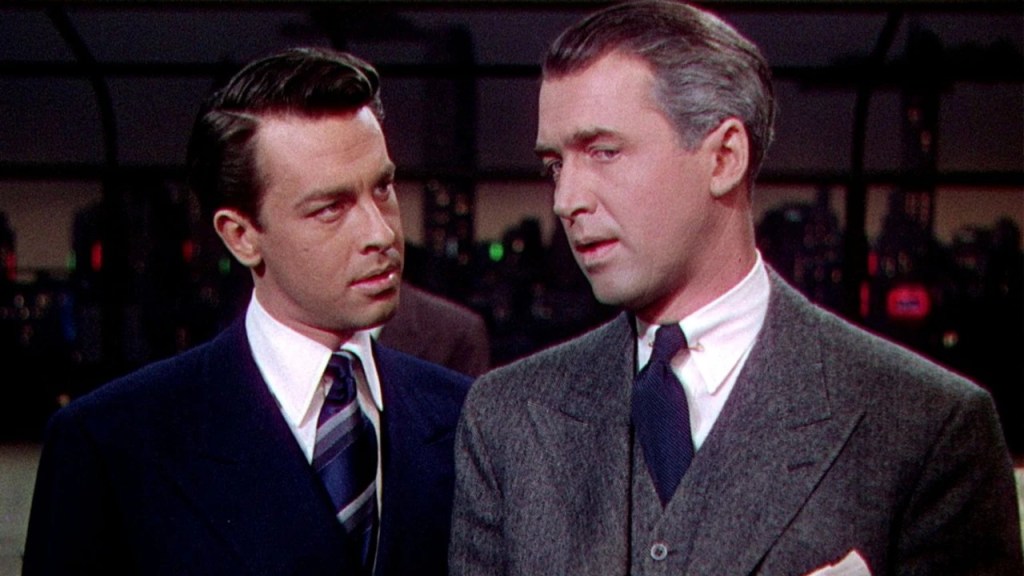
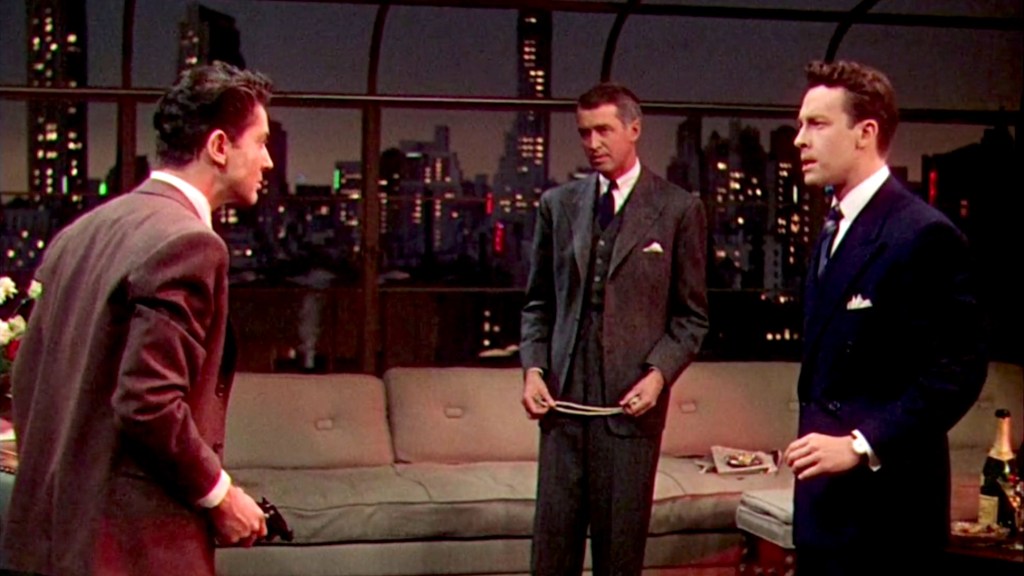
    From the onset, Rope is steeped in queer…well, we can’t even call it subtext now, can we? The two friends and former classmates, Brandon and Phillip, share a one-bedroom apartment together in New York City. They decide to kill their prep school classmate, David, with a piece of simple, taut rope. This is done in the opening scene, and the camera lingers on the faces of all three characters, notably David, whose pain in his own death could be misconstrued as almost arousal. All three men are packed closely together, hands across one another’s bodies, to commit this deed. 

    Throughout the subsequent dinner party, Brandon and Phillip are staged physically close—often shoulders against one another—and discreetly reminisce about the sensations the murder filled them with, along with their superior intellect for committing such a crime.

    Brandon says, “We’ve killed for the sake of danger and for the sake of killing. We’re alive, truly and wonderfully alive.” 

    Later, he remarks, “I don’t remember feeling very much of anything… until his body went limp and I knew it was over. I felt tremendously exhilarated.” 

    There are innuendos throughout about not just the pair’s homosexuality, but that of both their murder victim and their prep school housemaster, Rupert, who appears halfway through the film. Brandon notably says, “I’m not interested in Janet’s prattle, but you always interest me, Rupert.” 

    The innuendos of homosexuality likely flew over Republican James Stewart’s head as the elder intellectual, but they certainly didn’t for others in the cast and crew. 

    Rope, based on a 1929 stage play of the same name by Patrick Hamilton, was loosely inspired by the real-life murder of 14-year-old Bobby Franks in 1924 by University of Chicago students Nathan Leopold and Richard Loeb. Leopold and Loeb, having been in a relationship, were determined to murder as a means to tout their “superior intellect” and commit the “crime of the century.”  

    Hamilton himself was a closeted gay man and the screenwriter for the film, Arthur Laurents, was also gay–and one of the few openly gay Hollywood screenwriters in the 1940s. He and Hitchcock had a productive working relationship. Laurents said in an interview with Vito Russo for his book, The Celluloid Closet, “We never discussed, Hitch and I, whether the characters in Rope were homosexuals, but I thought it was apparent.” 

    Laurents had been drawn to write the screenplay for Rope because his then-lover, openly bisexual actor Farley Granger, was set to star as one half of the murderous duo, Phillip. The other half of this duo, Brandon, was also played by closeted gay actor, John Dall. On top of this, Brandon and Phillip’s murder victim, David, was played by Dick Hogan, yet another gay actor who had previously been with Farley Granger. 

    In writing the script for Rope, Laurents had a delicate balancing act given that the Hays Code was at its peak in enforcement. The Hays Code was a set of censorship guidelines for the film industry, which barred any “unacceptable” content in films, such as homosexuality. Laurents said, “I don’t think the censors at that time realized this was about gay people. They didn’t have a clue what was and what wasn’t, that’s how it got by.” 

    Hitchcock, though not initially intent on crafting such a queer film, had begun working on Rope to push back from the studio system which he had been trapped in for years (also using Rope to employ groundbreaking filming techniques to create the illusion that the film was done in one continuous long take). He, in many ways, sympathized with queer artisans and characters. 

    Hitchcock was more than willing to cast queer actors, wishing to promote and elevate struggling performers who, like himself, wished to push back on the studio system. Stewart, as the most bankable star, was cast to quell censorship concerns and to secure financing. But all the other primary persons associated with creating and starring in the film were keenly aware and eager to showcase queer characters less in a villainous light, but in a complex one.

    Laurents and Granger even had a double date with Hitchcock and his wife, Alma. Laurents said of Hitchcock, “He didn’t give a hoot in hell whether I was gay. It tickled him that we had a secret he knew. It was a slightly kinky touch, and kink was a quality devoutly to be desired.”     

    There were missed opportunities with Stewart’s casting, however. Laurents lamented that Stewart’s character was supposed to be the unwitting, queer inspiration for the murderers. In Laurents’s words his character was, “the head homosexual…Jimmy Stewart? Jimmy Stewart has no sex.” 

    Still, the film carries on with its queer imagery and textual assessment of vice–from smoking cigarettes after murder to stroking champagne bottle necks, all of which can be tied back to the queerness of the story.   

    Phillip and Brandon are, despite being murderers, the film’s protagonists. As an audience member, one is keenly aware of the malicious deed committed at the onset, but can’t help looking away and being charmed by the murderers. While not necessarily a positive representation of homosexuality, what Rope did was employ queer artisans in a time when punishment for sodomy in California included forced sterilization; Hitchcock crafted a thriller steeped in homosexual undertones, queer history, and evoking tawdry, sensuality between multiple characters. 

    Most essentially, the film addresses fascist ideology head-on. The murderers commit their crime after having learned of “superior intellect” from their mentor, but by the end, their headmaster rejects this thought experiment that individuals of “superior intellect” can or should dictate the lives (and deaths) of others. Hitchcock had crafted anti-fascist British propaganda during World War II and Stewart had served in the Army during the War. In the end, it’s not the homosexuality of the characters that’s repudiated, it’s their fascist thoughts, which can be held even by members of the larger queer community (I’m looking at you, “LGB without the T”). 

    Even prior to Rope’s release, the film received backlash and was either banned or severely restricted across such major cities as Seattle and Atlanta. The film was also met with mixed reviews and wound up being a financial disappointment, though not an outright financial failure thanks in no small part to its small, $2 million budget. Since the 1940s, Rope has been reassessed and, while not as appreciated as some of Hitchcock’s other films, has endured because of its bold stylistic cinematography and use of long takes, as well as its queer storytelling and complex depiction of queer characters.   

    Rope is the queerest of all thrillers perhaps not because it’s the most shocking or graphic of queer stories put to screen, but because of all that was put into the film by its multifaced creators and actors, all that the film says about vice, kink, and ideology, as well as all that the film implies through inventive cinematography and editing.