Tag: queer

  • Playing Dress Up

    Playing Dress Up

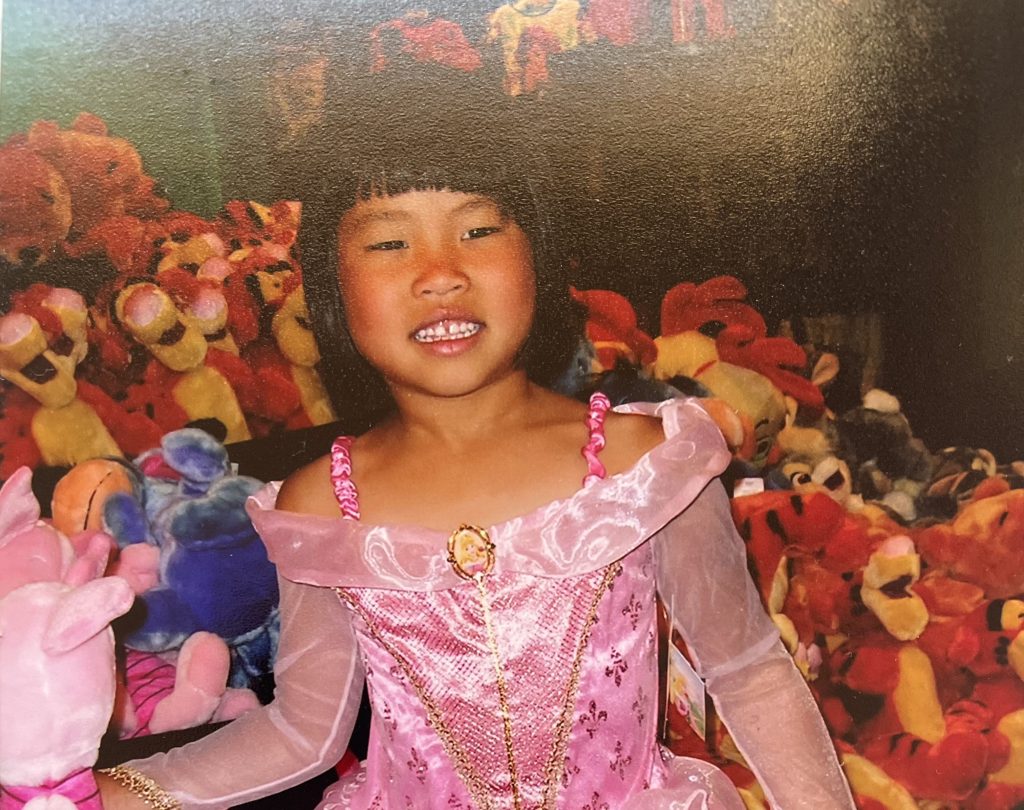
    I don’t remember a lot from my childhood. There’s no deeper reason like I’m trying to forget certain events or particular people–it’s not that serious; I simply have a bad memory. However, amongst the collection of things I do remember, like my old childhood best friend’s birthday and Greek alphabet song, are the consecutive Halloweens I spent dressing up as Sleeping Beauty. Everything about the holiday besides my costume is a blur and frankly unimportant. In my memory, it was all about the dress.

    Like many six-year-old girls, my favorite color was pink and this dress was my perfect shade. It had stretchy silk-like straps that looked like scrunchies attached to a tulle off-the-shoulder neckline that revealed my childish decolletage. In the middle sat a pendant with Sleeping Beauty herself. The sleeves were full length and ended at my wrists with a piping of gold stitching. The bodice held the most detail, with a v shape joining in the middle made with that same gold stitching, to create shape where there was none. Fleur de lis littered the top and bottom of the dress and shimmered in the light. I adored this dress, getting much more wear out of it than just once a year. I have a picture of me at six years old wearing it to the mall on a random Monday in August. At the time, I’m sure it was the color that lured me to it, but as I reflect now, it’s apparent that there was a part of me who loved it because I could finally be something that everyone else was. I wasn’t the adopted Asian girl with white parents, I was Sleeping Beauty. I had blond hair and fair skin and a prince who would do anything for me. I may have looked different but my dreams were the same. 

    Eventually, I grew up and the dress was passed on to someone else, and I was still chasing that feeling of belonging. Growing up in a small town meant that I was among only a handful of other Asians. As a whole, I was met with kindness, but to exist meant to stick out, and so I did my best to exist quietly. I fell in with the right crowd: friends from well-known families in the community who were popular but kind, and smart but humble. I excelled in school enough to remain in step with my friends but not enough to be noticed. I participated in student government but ran for historian instead of president, and joined the cheer team, choosing the position that faced away from the audience instead of towards it. I didn’t come out as queer until I was 16, though I knew a lot earlier than that. I couldn’t stand being even more different than I already was, so I sacrificed my love for uniformity. This became my new costume, which I wore comfortably and without hesitation. I didn’t stand out at all, and that’s exactly what I wanted. What felt like a persona at the time became synonymous with who I was. Before I knew it I was floating through life content with being 70% happy, so long as on the outside it looked like I was 100%. I didn’t find that last 30% until I was 22 years old. When I first met my now-girlfriend, I couldn’t believe that life was meant to be this good. The way our lives intertwined so seamlessly made me believe that that’s how it should have been all along. As someone who lives their life with bated breath, I didn’t think I’d ever find someone who felt like fresh air.

    The costume I had eagerly worn to survive had become my skin. It was the good things now that felt like make-believe. I would come home from a day of holding hands and writing love notes and look in the mirror and see a stranger. She looked like me, but there was a quality about her that was different. She shimmered, like how heat radiates off of the pavement on a hot day and how the air almost looks like it’s vibrating. Patches of my old self would reappear in moments of vulnerability or anxiety, but as time went on I started to shed my old skin. 

    It took my whole life to get to this point, but it doesn’t feel like I’m playing dress-up anymore. I used to have to pretend to be someone else to feel like enough, but now there’s no one I’d rather be than myself. I still experience all the hard parts of life, like everyone else, but I can find comfort in knowing that trying to suppress who I am is no longer one of them.

  • Take It or Leave It

    Take It or Leave It

    by Jocelyn Diaz

    I’ve found myself dissociating more than usual. It’s been so hard for my brain to accept that I was in a different country last week, and now, I’m back in California. I went from speaking Spanish in Spain every day, teaching English to young kids, to saying “No, yeah, for sure, I appreciate you asking” when the barista at Peet’s Coffee asks if I want alternative milk. 

    The job search hasn’t exactly been confidence-building, with most companies not directly rejecting me, but simply not responding. I try to tell myself that maybe they’ve found someone already, and simply haven’t taken the advertisement down yet. Then I see the advertisement being reposted a few days later and struggle not to take it personally. Without homework assignments and with no job, I have so much time on my hands, like I’m on summer vacation but it’s January. And I don’t have those anymore anyway since I graduated last June. 

    Even worse, or maybe less ideal, is that I’m back in my hometown. I graduated college a year early for my age, so a lot of my conocidos are no longer on Christmas break and are starting their Winter Quarter. I still get scared that I’ll see someone from middle school or high school, but so far I’ve yet to encounter anyone. 

    I saw this TikTok saying that when you feel like you’re in a slump, you should try one new thing every day to switch up your routine. I sit in the Peet’s parking lot and lazily stir my iced matcha with oat milk because it’s not my new thing to get matcha, more like a reason to leave the house. As I drive away, I think about what will be my thing today, something that’s cheap or free, if that’s even possible. I don’t want to drive aimlessly without a plan because I don’t have the gas money to do so and decide to make my way back to the house when I notice a sign that says “TAKE A BOOK LEAVE A BOOK.” I do a loop around because I’m genuinely curious about what kind of books the general public decides to donate. Plus, I want to pick up something new to read, while I wait for my library card in the mail. 

    I see a lot of self-help books, some cookbooks, and the book 1984. I was half-expecting to see those cheesy romance books with a Fabio-looking man on the cover, holding a swooning woman with one hand. I kinda wanted to read one of those, just for the fun of it. But before I close the door to the little book nook shaped like a birdhouse, I see a cartoon girl on the cover of a book. At first glance, I think it’s a puberty book titled “TOTALLY ME!” Yet the figure of the girl with a short, yellow bob and chunky platform orange sandals is too familiar, and I suddenly remember the show I used to watch every night with my best friend Mimi, Lizzie McGuire. I was named after my grandmother Elizabeth, so I pretended that I was Lizzie, and she was Miranda because that was her name in real life too. On my eighth birthday, when my parents gave me a cat for my birthday, I named him Gordo. We had our version of the show, and it was beautiful and perfect. 

    Once the wave of nostalgia settles down and my judgment of whoever donated a Lizzie McGuire book, much less who wouldn’t want to take it home, I realize it’s a diary, not a book. I quickly skim through the leftover pages; the missing ones likely ripped out by the previous owner to maintain confidentiality. I imagine using the cover as a collage in my diary, which is good enough for me for my “something new.” 

    When I get home, I set up my desk with my collaging supplies and rip off the journal’s cover, which loosens its spine and causes a few pages to fall on my floor. I grab the last page of the pile and notice the imprint of words left behind by this mystery writer become more prominent through the light from my lamp. Luckily, I remember how popular invisible ink pens were in the early 2000s, as I hold the page closer to the lamp and can make out more words. And as invasive as it feels, I can’t stop reading.  

    Dear Diary, 

    We watched Lizzie McGuire, all night, again. JK! It was like 10 pm. Her bedtime was 8 pm but we wanted to keep watching TV, so anytime we heard footsteps, we turned down the TV and pretended to be asleep. It was so much fun! Lizzie keeps saying that Miranda is so beautiful. That she loves her crazy hair and style. I notice that her saying these words makes my stomach warm and fuzzy. IDK why. Lizzie is my BFF and I am hers. Like when I say my prayers every night, I always pray for her the most. Is this what God feels like when he thinks of me? Mom says that I’m God’s treasure. That I’m his favorite person. I know what he means. Lizzie is pretty, smart, and super cool. I love her sooo much. Don’t tell anyone Diary, but I think I like-like her. What am I going to do? 

    Love, Miranda 

    Tears well in my eyes. I always told her that Miranda was my first TV show character crush on a girl. My Miranda, or Mimi, as she has gone by since high school, had a crush on me when we were kids. I had no idea. Oh my god. Did I like her too? Oh my god. 

    I forget about the collage altogether, and, instead, scurry up to the attic and quickly rummage through box after box, not caring about the mess I’m making right now. 

    Eventually, my hands find the same diary as Mimi’s, as if there was a two-for-one diary discount at the store. I run back to my room to open the diary, leaving the attic worse than before. Again, pages are ripped out for some reason as I frantically scan each page under my lamp with no trace of invisible ink. Until I find one page. 

    Hi,

    Mom says that I need to try journaling for my anxiety. I don’t know why I feel so sad and scared all the time. Watching Lizzie McGuire with Miranda helps me. Just having her next to me makes me calmer. IDK if she knows but watching the show with her is my favorite part of the day. We both have bangs like Lizzie and Miranda, and one time her hair was sticking up like when you rub a balloon on your head. I tried to smooth it down with my hands and then my cheeks got warm so I drank water and looked in the mirror and my face was as red as a tomato. It was so weird. Miranda is my BFF and every time we have a sleepover I always tell her I love her just in case something happens. She always says it back. That makes me happy. Anyways, my hand hurts, and writing in a journal is stupid. And no, stupid isn’t a bad word. 

    – Lizzie 

    I trace over her writing in pen and send Mimi a picture of her diary entry without thinking about how out of the blue it is. Before I can figure out a follow-up text to the picture, she responds immediately.

    Surprise?

    I text her back a picture of my entry, also rewritten in dark ink.

    Surprise. 

  • An Accumulation of Poetry from Bethany Clark’s Original Book A 24 Year-Old Girl

    An Accumulation of Poetry from Bethany Clark’s Original Book A 24 Year-Old Girl


    One girl made me so upset. 

    Afraid. 

    Not of her, 

    But rather 

    The butterflies in my stomach. 

    The “it” girl. 

    Beautiful, funny, smart and kind. 

    Perfection in the flesh. 

    How could anyone ever love me 

    When they could have her? 

    “It’s okay for others, but I could never!” 

    This silent mantra subliminally messaged me constantly. 

    One day I realized I am worthy of the same grace I extend to others. 

    I want to kiss a woman. But not because I’m drunk, or want attention, but because I want to. Because I like her smile and the way she laughs. Because she gives me butterflies. I want to run my fingers through her hair and hold her hand, stay in bed until 11 on a Sunday and know how she takes her coffee. I want to exchange our hopes and dreams, have dinner with her mom and laugh at old baby pictures. 

    There she was in pixels 

    Illuminating in front of my eyes. 

    Oh there you are, 

    There’s the love of my life. 


    A note from the poet: 

    While writing these poems for my first book, A 24 Year-Old Girl, I was struggling with the aftermath of heartbreaks, the transition into adulthood, and you guessed it: my sexuality. My sexual identity was always something I questioned, but being that I had only ever dated cis, straight men, I never fully allowed myself the chance to explore as I was otherwise committed. Once I found myself single, and deep in the throws of self-improvement, queer discovery wasn’t far behind.

    I struggled for a long time with finding a label for my sexuality. I knew I wasn’t straight, but I felt as though I didn’t fit in any particular box. I suppose if you were to put a gun to my head I would say I’m pansexual, but the artist in me prefers the terms “queer” or “fluid.” Trying to define my sexuality ended up limiting the expression and exploration I needed to be out and proud. If I waited any longer to have the proper name for myself, I would be waiting forever. 

    To me, sexuality is a beautiful, complex, and fluid thing that cannot be described with a label. So I decided to stop trying to understand what I was, and embrace being a member of the community in some way, shape, or form even if I didn’t know how. Like I’ve always known, I am not straight, and at last, that is enough for me. 

    I have friends who love their labels of trans, lesbian, bisexual, etc. because it makes them feel seen or gives them an understanding of themselves; I applaud them! The main takeaway from my personal growth I want to share with you, reader, is to allow yourself a chance to breathe. 

    Remember, there are no rules, it truly is not that deep. There is no “right” way to discover yourself, and it is okay for you to belong to one community and one day find another that feels like home. We are multifaceted beings, constantly evolving and are “worthy of the same grace [we] extend to others.” 

    Peace & luv, 

    Bethany Clark

  • Reflection Piece

    Reflection Piece

    by Honor

    They tried so hard for you. Please keep trying. In 20 more years, you can start to finally see yourself and you will do anything to let that happen. You’re not disgusting. Not embarrassing. Not to be ashamed of.

    Please. Honor. You will make this happen. We won’t let our life pass us by.

    Please don’t let it, okay?

    Love, Honor

  • My Queer Reading List in 5 Books

    My Queer Reading List in 5 Books

    by Kath Miller

    Books have always been a tool for me to better understand myself and the world around me, but a sub-genre I have become increasingly interested in is queer literature. After several years of exploring the genre, there are 5 books in particular that stand out as important recommendations. And, except for one entry, they all have some sort of happy or satisfying conclusion that doesn’t result in too much queer suffering. So, allow me to walk you down a list of the 5 queer books that I think are worth your time.

    #5. Pulp by Robin Talley 

    Told in dual perspectives, Pulp by Robin Talley follows Janet Jones, an eighteen-year-old in 1955 who is coming to terms with her own queerness, and Abby Zimet, a modern-day teen whose senior project is 1950s lesbian pulp fiction. Abby is fascinated with one author in particular, Marion Love, and longs to track her down and find out who she really is. 

    This was a novel I picked up in the throes of the COVID-19 pandemic, but it has stuck with me after all this time due to the real pieces of history surrounding lesbian pulp fiction that permeates throughout the book, as well as an extensive list of published lesbian pulp fiction of the time that the author included in the index. While the book is written with a YA audience in mind, it is definitely worth picking up if you are at all curious about the subject matter. 

    #4. All the Young Men by Ruth Coker Burks

    All The Young Men is a devastating, informative, and hopeful memoir all at the same time.

    The subject of our story is Ruth Coker Burks, who in the midst of the AIDS crisis, went out of her way to house, feed, and befriend AIDS patients whose families had abandoned them, primarily in the Arkansas area. This memoir reveals the ugliest sides of humanity–families abandoning their sons due to their sexuality and the misinformation and inaction from the US government. However, it also reveals the good, as the relationships Coker Burns develops with these young men and her overwhelming kindness restores one’s faith in humanity a bit. I definitely recommend it for its examination of the AIDS crisis from a unique angle.

    #3. Tipping the Velvet by Sarah Waters

    Funnily enough, I discovered this book on an assigned reading list for one of the last classes I took in my undergraduate studies; I have such clear memories of sitting in my university’s library for hours and just tearing through the novel. It was one of those books I finished before its due date… that’s how good it was.

    This novel is set in Victorian London and follows Nan King, a young girl from Whitstable, Kent, who gets swept up in the male-impersonation music hall scene of that time upon meeting her idol Kitty Butler. This novel is particularly interesting with how it chooses to use the music hall space–creating a liminal space for the queer characters to exist without fear of violence from the public, which is an idea that continues on past the music hall chapters as well. Queer suffering not being the subject of this novel also makes it so refreshing as a reader, especially combined with the deconstruction of Victorian gender norms, making it a deeply gripping read. 

    #2. Fried Green Tomatoes at the Whistle Stop Cafe by Fannie Flagg

    Set in the late 1980s, Fried Green Tomatoes at the Whistle Stop Cafe tells the story of Evelyn and Mrs. Threadgoode–a middle-aged housewife and an elderly woman living in the same retirement home as her mother-in-law. During each of Evelyn’s visits, Mrs. Threadgoode begins telling the story of another two women–Idgie and Ruth–who ran a barbecue restaurant in Whistle Stop, Alabama, back in the 1930s. 

    This book has always stood out to me as it was one of the first books I ever read that depicted a lesbian romance. That and it made me laugh, cry, and turn the pages at an alarming rate to follow the twists and turns of the plot. It’s a heartwarming read and a very wholesome exploration of relationships between women–platonic and romantic. You won’t regret it!

    #1 The Color Purple by Alice Walker

    The Color Purple was a book I had been urged to read for many a year before I finally purchased a copy and picked it up in the summer of 2023. My older sibling ultimately got me to read it.

    “It’s about lesbians who live together and make pants,” they said, and they have great taste so I gave it a chance. My only regret is that I did not read it sooner

    Winning the Pulitzer Prize for Fiction in 1983, Alice Walker’s The Color Purple follows Celie, a poor Black girl living in rural Georgia in the 1900s. Celie’s story is one of horrific abuse that turns into one of self-discovery and empowerment. While the queer themes are not the central focus of this narrative, it is Celie’s relationship with Shug Avery that teaches her to love and value herself. This is my favorite book of all time and while it may not be as explicitly queer as the  other entries, I simply had to include it as a book I think every single person should read.

    Thus concludes my list of 5 queer books I think are worth reading. Seeing as how since the dawn of queer media, queer suffering has always been a low-hanging-fruit trope. Therefore, I was motivated to include books that showcase queer perseverance and strength. It is important to show queer readers of any age that hope and love can exist even in the face of tragedy. 

    I hope some of these entries made it onto your reading list and hopefully as I read more books in 2025, I will be able to expand upon this list with another! Thank you for reading. 

  • A Crisis In Sex Education

    A Crisis In Sex Education

    When it came to my high school sex education, LGBTQ+ issues got a single slide in a powerpoint presentation and here’s what I learned: there is no cure for HIV, wear a condom if you have anal sex, and transgender people exist. That was it. As high school continued, I learned about sexual injuries not from the curriculum, but from two different queer classmates, one of whom ended up in the emergency room. Both young adults, like me, were unaware of the crucial safety measures specific to anal sex. These injuries could have easily been prevented if we had been properly educated. However, despite its failure, my high school sex education was still better than most. I have met several individuals who received no mention about the queer community in their sex-ed classes at all. This needs to change. No student should have to learn about such avoidable dangers through traumatic experiences.

    The current standard for sex education in America heavily prioritizes heterosexual, cisgender students. It overlooks the needs and dangers specific to the queer community. According to the CDC, in 2020 alone, 20% of HIV diagnoses were people aged from 13 to 24. Despite the preventable nature of this issue, only 6% of high school students have been tested for HIV. And while it varies from state to state, data from School Health Profiles: Characteristics of Health Programs Among Secondary Schools shows that 39.3% of lead health education teachers from high schools across the nation received professional development on how to support LGBT students. That means that in most cases, queer students are left to their own devices, which can lead to increased spreading of STIs as well as sexual injuries.

    Conversations about testing, PrEP (an HIV preventative medication), and being undetectable make all the difference, not only in making sex less scary for queer youth, but making it safer. And while the LGBTQ+ community is the most at risk, HIV affects everyone.

    It’s important to recognize there is a disproportionate awareness between heteronormative and queer sex in society at large. Traditional “straight sex” is prominently represented in nearly all forms of media: TV shows, movies, books, songs, etc. Consequently, most people grow up and learn about that version of sex, even if it’s not explicitly taught. This is not to imply that heteronormative sex needs less coverage, rather, emphasize the importance of giving equal weight to queer sex education.

    Sexual education is a powerful resource and it should be accessible to everyone. The next generations deserve an education that is more inclusive, one that helps them navigate the world, regardless of their gender and sexual identities.